Bonj Beach in Hvar Town – A Historic Bathing Spot with Stone Sun Terraces and Views of the Pakleni Islands
Bonj Beach is one of the most famous urban bathing spots in Hvar, located on the western side of the town along the promenade that connects the historic core with the Amfora Hotel area. It is well-known for its distinctive stone terraces, white columns, and elegant architecture from the early days of Hvar's tourism. Alongside the well-maintained sunbathing areas, there is also a pebbly section of the shore, while the clear waters and views towards the Pakleni Islands make Bonj an attractive spot for swimming and relaxation. The beach uniquely combines a public bathing area with facilities for guests seeking additional comfort, including sun loungers, umbrellas, and catering services. Thanks to its proximity to Hvar's centre, Bonj is an excellent choice for a few hours by the sea without the need for a car or boat transport.
Bonj Beach – One of Hvar's Most Recognisable Bathing Spots
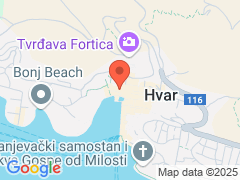
Bonj is situated in a small cove west of Hvar's port, along the coastal promenade that leads from the town's waterfront to the beaches of Majerovica and Podstine.
It takes approximately ten to fifteen minutes to walk from St. Stephen's Square to the beach, following a pleasant path by the sea.
Its location just below the Amfora Hotel area makes Bonj easily accessible for visitors staying in the town centre as well as those located in its western part.
Unlike more remote natural coves, Bonj has a distinctly urban character. The coastline features a mix of stone sunbathing areas, pebbly sections, well-maintained terraces, and relaxation spaces.
The view of the Pakleni Islands, with their wooded islets stretching out before Hvar's western coast, adds to its charm.
Bonj is particularly appealing to visitors who wish to combine swimming with sightseeing, dining, or an evening stroll along the waterfront.
The History of Bonj Beach – Elegant Architecture of Hvar's Tourism
One of Bonj's greatest features is its historical architecture.
The development of the organised bathing area is linked to the early decades of the 20th century when Hvar began to establish itself as a destination for relaxation, recuperation, and seaside stays.
During this period, organised bathing spots with changing cabins, stone terraces, staircases, and spaces designed for the comfort of guests were created.
Bonj became one of the most recognisable places of such development.
Notably, the white stone columns, elegant arcades, and terraces built right above the sea give the beach a different appearance compared to Hvar's natural beaches.
The historic section is also known as Bonj les Bains, alongside which a modern beach club has developed.
Due to the unusual combination of older bathing architecture and modern tourist facilities, Bonj today attracts not only bathers but also architecture enthusiasts and those interested in the history of tourism.
What is Bonj Beach Like? Pebbles, Stone, and Well-Maintained Terraces
The shoreline at Bonj consists of smaller pebbly sections, rocky surfaces, and organised sunbathing areas.
The pebbly section allows for a gradual entry into the water, while from certain stone terraces and bathing platforms, access to the water is via steps.
This variety enables different ways to enjoy the beach.
Visitors who prefer traditional swimming can choose the pebbly area, while the flat stone surfaces are suitable for sunbathing and relaxing by the sea.
The water is clear, and the seabed along the shore combines pebbles and rocks. In rockier areas, water shoes are advisable, especially due to the presence of sea urchins.
At certain access points via platforms, the water depth increases more quickly than in the pebbly area, so it is important to choose an entry point that matches swimming abilities.
Bonj is not a wide sandy beach but rather an organised urban bathing spot, whose uniqueness lies in the combination of natural shoreline and historic stone terraces.
Is Bonj Beach Public and Is There an Entrance Fee?
One of the most important questions for visitors concerns the difference between a public bathing area and an organised beach club.
There is no entrance fee for swimming in the public section of Bonj Beach.
Alongside the publicly accessible parts of the shore, there are organised zones with amenities that incur additional charges.
Renting sun loungers, umbrellas, and using certain special relaxation zones is not included in the free use of the beach.
The historic complex Bonj les Bains, now also known through the Beach Club Hvar offering, is intended for visitors who want a more organised seaside experience, with loungers, comfortable relaxation areas, and catering services.
For visitors who simply want to swim and spend a few hours at the beach, such services are not necessary.
During July and August, the public sections of the shore can become busier, so it is best to arrive earlier in the day to find a pleasant spot.
Sun Loungers, Umbrellas, and Amenities by the Sea
Bonj is one of the better-equipped beaches near Hvar's historic core.
During the tourist season, sun loungers and umbrellas are available by the bathing area, and in the organised sections, more comfortable spaces for all-day stays are offered.
Nearby, there are restaurants and bars, so visitors do not need to leave the coastal area for refreshments or meals.
Practical amenities such as showers and changing areas are available in the bathing area, along with possible restrictions on the use of certain services belonging to the beach club.
The historic section with stone terraces and arcades is particularly interesting, providing a different atmosphere from typical pebbly beaches.
For guests planning to spend the entire day at Bonj, additional amenities can be practical, while for a shorter visit for swimming, the public section of the shore is quite sufficient.
Bonj les Bains and Beach Club Hvar – The Historic Part of the Beach
Bonj is also known for its unique bathing complex, whose architecture resembles fashionable European resorts from the early 20th century.
The white columns, stone arcades, and well-maintained platforms above the sea create a recognisable sight along Hvar's western coast.
The historic name Bonj les Bains is still used for this part of the beach, while the modern catering offering is associated with the name Beach Club Hvar.
This is an organised space for sunbathing, relaxation, and serving food and drinks.
Thanks to its position above the clear waters and views of the Pakleni Islands, it is particularly appealing to couples and visitors seeking a more comfortable day at the beach.
It is important to distinguish the services of the beach club from swimming in the public area. Staying in reserved zones, using special loungers, and other additional services may incur separate charges.
Swimming and Conditions at Bonj Beach
Bonj is attractive due to its clear waters and easy access from the town.
The cove features sections of the shore where the water gradually deepens, as well as rocky platforms providing access to deeper water.
For families with small children, the pebbly sections are more suitable, as they allow for easier monitoring of entry into the water.
Swimmers who prefer to enter via steps can use the organised access points, keeping in mind the depth and conditions of the water.
Due to the rocky seabed in certain areas, it is advisable to wear water shoes.
During the summer months, the cove is popular, with the highest number of visitors gathering from late morning to afternoon.
Those seeking a quieter swimming experience and a greater choice of spots by the sea will do best to arrive in the morning.
Views of the Pakleni Islands and Sunset
One of Bonj's most beautiful features is the open view towards the Pakleni Islands, a group of wooded islets stretching out before Hvar Town.
From the bathing terraces and coastal promenade, the sights of sailboats, motorboats, and yachts sailing between Hvar's port and the surrounding islands are particularly captivating.
During the day, the sea takes on various shades of blue and turquoise, depending on the light and weather conditions.
In the evening, the western part of Hvar's coast is beautifully illuminated with warmer tones, making Bonj a pleasant place for relaxation and photography.
For visitors who do not wish to spend the entire day at the beach, even a short walk along the bathing area offers a lovely view of the sea and one of the most recognisable parts of Hvar's coastline.
How to Get to Bonj Beach?
The easiest way to reach Bonj is on foot from the centre of Hvar Town.
From the main town square, head towards the western side of the waterfront, then continue along the coastal promenade in the direction of the Amfora Hotel.
The path runs alongside the sea and offers views of Hvar's port, the Pakleni Islands, and the western coast of the town.
The walk takes approximately ten to fifteen minutes, depending on your starting point and walking pace.
The access is straightforward, without any challenging hiking or long descents down steep paths, making Bonj practical for daily swimming during your stay in Hvar.
It is also possible to reach the wider area by car or taxi, but the coastal promenade is designated for pedestrians.
Bonj does not have a traditional public parking area directly at the bathing section of the shore. For those arriving by car, it is more convenient to use the permitted parking areas in the western part of the town or on its access roads and then continue on foot.
What to Visit Near Bonj Beach?
Bonj is an excellent starting point for exploring the western coast of Hvar Town.
In the immediate vicinity is the Amfora Hotel area, with well-maintained coastal promenades and tourist amenities.
Continuing your walk westward leads to Majerovica Beach, and further along are Podstine and other smaller coves.
In the opposite direction, towards the centre of Hvar, you will reach the town's waterfront and historic core.
Here, it is worth exploring St. Stephen's Square, the cathedral, the Arsenal with Hvar Theatre, and the old town loggia.
Above the town rises the Fortica fortress, offering the famous panoramic view of Hvar's port and the Pakleni Islands.
A visit to Bonj can easily be combined with sightseeing in the town, a stroll along the waterfront, or dining at one of the nearby restaurants.
Who is Bonj Beach Best Suited For?
Bonj is particularly suitable for visitors who want to swim close to Hvar's centre while also enjoying the use of organised facilities.
Couples will find it appealing due to its elegant atmosphere, views of the Pakleni Islands, and the opportunity to relax on the stone terraces.
Architecture enthusiasts can appreciate the unusual appearance of the old bathing area, which differs from most beaches on the island.
Families benefit from the proximity to the town and the availability of the pebbly section of the shore, although care should be taken with certain areas that have rocky bottoms and a quicker drop into deeper water.
Bonj is less suitable for those seeking a large natural cove without tourist facilities or a wide sandy beach.
Its greatest advantage is the combination of swimming, historical bathing architecture, and pleasant stays by the sea, all within walking distance from Hvar's old town.
Useful Information
- Type of Beach: Organised urban bathing area with pebbly, rocky, and paved sections
- Surface: Small pebbles, stone, and well-maintained stone terraces
- Entry into the Water: Gradual in the pebbly section; via steps on certain bathing platforms
- Special Feature: Historical bathing terraces and stone arcades from the early period of Hvar's tourism
- View: Sea, boats, and the Pakleni Islands
- Entry: Public section of the beach is accessible without a ticket
- Sun Loungers and Umbrellas: Available for rent at a charge during the season
- Additional Amenities: Beach club, restaurants, and bars in the immediate vicinity
- Showers and Changing Facilities: Available in the bathing area, with conditions for using certain organised zones
- Natural Shade: Limited, with some shade in the surrounding coastal areas
- Recommended Equipment: Water shoes due to rocky seabed and possible sea urchins
- Child-Friendly: The pebbly section is more suitable than platforms leading to deeper water
- Access: On foot via the western coastal promenade from the centre of Hvar
- Distance from Centre: Approximately 10–15 minutes on foot
- Parking: Public parking in the wider western part of the town, then access on foot
- Best Time to Visit: Morning for quieter swimming; afternoon for sunbathing and sea views
- Nearby: Majerovica and Podstine beaches, Hvar's waterfront, and historic core
- Recommended for: Couples, lovers of organised bathing areas, historical architecture, and swimming close to the town centre


Bonj / Comments
Looks like you are not signed in!
How would you like to proceed?
Anonymous comment
Login
Register
Your comment was submitted successfully and it will be published after approval by administrator!
General Conditions of Publiciation
General terms and conditions and notes
1. Web page
Web page www.holiday-link.com is an interactive web page where the visitors can put texts, news, photos and video movies regarding the content about tourism, gastronomy, culture and entertainment. Information can be uploaded by the owners, managers, employees, tourist boards, residents and tourists, basically all those who want to introduce the public to the specific content (facilities). The site allows evaluation of the attractiveness of a specific content and it allows writing comments by other visitors. Visitors, who log in and want to publish an information about some content (facility) or promote some tourist service, become users or suppliers and they agree to the general terms and conditions that are stipulated here and are obliged to act in accordance with the general terms and conditions (general conditions do not apply if a person is only visiting the page). A person can become a user by signing up with a user name and a password. The user agrees to put the accurate access data, name and surname and the address. Contents that users publish will be signed with a nickname they choose, while the personal data will be used in accordance with the privacy statement. Persons under the age of thirteen are not allowed to enter any content. General terms can be changed from time to time and if the user or supplier doesn’t agree with the changed general terms and conditions he can remove his content from the site.
2. Content
The page is not the media that publishes editorial program contents but the page where the visitors publish information that serve for the educational and cultural public informing about the touristic, cultural and gastronomic contents (facilities). The goal of the site is to collect the information that will give the tourists, as well as the locals, the insight into touristic, cultural and gastronomic offer of the certain location (city, region and country). Publishing the information about the content (information on facilities) is completely free of charge. Except the touristic content , on these pages, providers of various services in tourism may publish and advertise services they offer. These are, further in the text, referred to as a suppliers. Users and suppliers are solely responsible for the publication of their contents in accordance with the statement of responsibility.
3. User obligations
Each user is obliged to use the website in accordance with the general terms and conditions. By publishing the certain text, comment, photo or video movie on the site, the user guarantees that the published information are true, and that they are not copyrighted by a third party. Each user is morally and materially responsible for the publication of content. It is forbidden to copy texts from other websites. Administrators review entered contents and approve them for publishing. Holiday-Link.com has the right not to show the content it finds inappropriate, untrue or offensive. The owners, managers or employees of the gastronomic facilities (eg. restaurants) have the right to reply to the articles and comments on their own content. The owners have the right to request the removal of the text regarding their facilities if they find it inappropriate. The complaint can be send to complain@holiday-link.com. By publishing the content, the user is giving the exclusive, royalty-free, perpetual transferable, irrevocable and fully sublicensable licence (copyright) to use, reproduce modify, adapt, translate, distribute, publish and publicly display subscribed content to the Holiday-Link.com and its affiliates.
4. The obligations of suppliers of tourist services (accommodation and other services)
Company Holiday-Link.com Ltd acts as advertising website on this website and not as a tour operator or intermediary travel agency. Suppliers of tourist services who register their capacity on this site, pay the commercial advertising model they choose. Interaction, regarding arranging a specific accommodation or other tourist service, is done directly between supplier and visitor. Visitors arrange the accommodation or some other touristic service directly with the suppliers and pay the arranged service to them. Suppliers are responsible for all entered data, images, prices and more. Suppliers guarantee that they have all licences necessary to carry out the services they offer, and to operate in accordance with the laws of their home country. By purchasing certain service, visitor accepts the terms and conditions of a supplier from whom he purchased the service. Holiday-Link will check each supplier before putting its facilities to be visible on the page.
5. Statement of Responsibility
The information, that users and suppliers are entering, can be wrong. Holiday-Link.com does not check the entry of the information, pictures and movies and cannot guarantee their accuracy and it disclaims any responsibility for any incorrect data. If you notice a certain misstatement, inaccuracy or inadequacy in any content, please contact us by e-mail: complain@holiday-link.com The responsibility, for every information about some content, is on the user who entered the information. Suppliers, who advertise touristic services via this website, act as independent entrepreneurs. They enter the data about their services , as well as the pictures and the prices, on their own. Holiday-Link.com does not check entered data and disclaims responsibility regarding the errors that can occur during the entering. Suppliers have to own all the licences regarding the services they offer, and they have to respect the laws and regulations of the home country. Visitor arranges the specific service directly with the supplier, on the basis of data that is entered by a supplier as independent entrepreneur, and he pays it directly to the supplier. Therefore, Holiday-Link.com disclaims responsibility for any problem related to the certain reservation.
6. Privacy Policy
When logging into the website, users and suppliers have to enter some personal data (name and surname, e-mail, address, phone number, etc.). Holiday-Link.com guarantees that this data will be kept secret and will not be forwarded to the third parties. Holiday-Link.com can use an user and a supplier e-mail for sending necessarry informaion and for advertising.
7. Cookie Policy
Cookies are small text files that can be stored into device of a visitor if it is allowed by a web browser. Holiday-Link.com uses cookies to provide a better user experience on the website for the visitors. Also, while visiting Holiday-Link.com, you can automatically collect a certain data.
8. Court Jurisdiction
In case of any dispute, related to the site holiday-link.com, the court in Split and the Croatian law are competent.