Kaštel Komuna and the Fishing Museum in Komiža
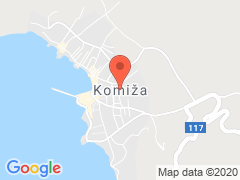
Kaštel Komuna is one of the buildings that is hard to miss while strolling along the Komiža waterfront. It stands on a small promontory by the harbour, almost at the water's edge, and behind its massive stone walls lies the Fishing Museum Komiža. Unlike many fortifications that are primarily visited for their architecture, Komuna is interesting because it connects two of Komiža's most important stories in one visit – the defence of the old town and its centuries-old fishing tradition.
If you are in Komiža and can only visit one museum, this is the most logical choice. The exhibition is not extensive and does not require half a day to explore, but it makes it much easier to understand why motifs of the falkuša, Palagruža, sardines, and fishing regattas are so prevalent in Komiža.
The fortress was not funded solely by the Venetians – it was built by Komiža fishermen
The castle was erected at the end of the 16th century, at a time when Komiža needed a more secure defence for its harbour and inhabitants due to attacks from the sea. Above the entrance is an inscription related to the Duke of Hvar and Vis, and the proveditor Ivan Grimani, stating 1585 as the year of construction.
However, a more intriguing detail lies on the northern wall.
Komuna was not completed solely with state funds from Venice. Part of the financing came from the fishermen of Komiža, who contributed from their earnings at the fishing station Trešjavac, south of Biševo. In other words, the fishermen helped fund the fortress that was meant to protect them, their families, and the harbour.
This detail is worth remembering as it illustrates how vital fishing was to old Komiža – it was not just a profession but the foundation of the entire community's life.
Look for the stone rings along the walls
While exploring the exterior of Komuna, it is easy to overlook some interesting details.
The northern and western walls were once directly in the sea, before the current coastline was constructed. On them, you can still see large stone rings for mooring sailing boats.
The walls also preserve openings for cannons and narrow gun ports, so the structure still clearly shows its defensive purpose from the outside.
Particularly noteworthy is the northern wall, where you can find a worn relief of the winged lion of St. Mark, a symbol of the Venetian Republic. This is a rare remnant of Venetian authority on the island of Vis.
The clock on Komuna came much later
The current appearance of Komuna is not entirely the same as it was in the 16th century.
After the Austro-Hungarian disarmament of Vis, the Komiža municipality purchased the castle in 1879 and adapted it for municipal offices. Some changes were made to the façades at that time, and a distinctive clock tower was erected at the corner of the building.
As a result, Komuna today resembles a blend of a defensive fortress and an old town palace. The lower part with its massive sloping walls clearly belongs to the fortress, while the clock and some later details remind us of the period when the building became the centre of local administration.
The Fishing Museum best explains Komiža
Within Komuna is the Fishing Museum, a fishing collection established in 1986.
Do not expect a large maritime museum with dozens of rooms. The exhibition is relatively compact but very specific to Komiža. This is its value – it does not attempt to recount the entire history of the Adriatic but rather shows how Komiža fishermen lived and worked.
Original fishing boats and equipment, various fishing tools, and items related to fish processing, which was once an important part of Komiža's economy, are on display.
There is also an interesting large collection of around 140 different fishing knots. To someone not connected to the sea, this may not sound particularly exciting at first glance, but such details demonstrate how much practical knowledge was once required in fishing, passed down from generation to generation.
The falkuša is the most important part of the story
The most famous part of the exhibition is related to the gajeta falkuša, a traditional Komiža fishing boat adapted for long voyages into open waters.
The falkuša was not used for short fishing trips a few hundred metres from the shore. Komiža fishermen would take it to distant fishing grounds around Palagruža and Jabuka, often on multi-day fishing expeditions.
Its distinctive feature was the wooden side panels – falke – from which the boat derived its name. These could be raised when it was necessary to increase the boat's beam for safer navigation in open waters and lowered when it was time to haul in nets.
This design allowed a relatively small wooden boat to be fast, capable of serious navigation, and well-suited for fishing.
The story of the last Cicibela
A special place in the story of the falkuša belongs to the Cicibela, the last original Komiža gajeta falkuša.
Built in 1925, it met its end in a powerful storm near Biševo in August 1986 after decades of sailing. This effectively marked the end of the era of original Komiža falkuša.
However, the tradition has been revived. Based on preserved knowledge, plans, and parts of the old boat, replicas of the falkuša have been made, one of which became an important part of showcasing Komiža's maritime heritage. The restored falkuša represented Croatia at the world exhibition EXPO in Lisbon in 1998.
When you see a falkuša under sail after visiting the museum on the Komiža waterfront or during a local event, the boat no longer appears merely as a beautiful traditional vessel. After the museum, it becomes much clearer why it is one of the symbols of Komiža.
Palagruža is key to understanding the museum
Many items in the museum make more sense when you know how far Komiža fishermen would go.
Palagruža is not a small island off the coast of Komiža, but a remote archipelago deep in the open Adriatic. Fishermen would sail there in wooden boats using sails and oars, primarily catching small pelagic fish, which they would immediately salt and store in barrels.
The right to the best fishing spots was so important that the Rota Palagruzona developed, a tradition of a regatta from Komiža to Palagruža. Faster crews secured better fishing locations.
Therefore, the Fishing Museum should not be viewed merely as a collection of old nets. It actually showcases an exceptionally demanding way of life where sailing, fishing, and knowledge of the weather, sea, and boat had to be perfectly integrated.
The interior of Komuna is also worth seeing
While attention is primarily focused on the exhibits, the building itself is also interesting.
The ground floor features heavy stone vaults supported by a central column, and among the architectural details is a Gothic arch. A narrow side staircase leads to the upper floor and the final part of the castle.
Inside, one can truly appreciate how massive the walls of Komuna are. From the outside, among the cafés and boats on the current waterfront, it is easy to forget that the building was originally a proper defensive fortress.
Those who find stairs challenging should note that the upper parts of this historic building are connected by a narrow staircase.
How much time is needed for a visit
A visit to the Fishing Museum does not require several hours. About half an hour to an hour is sufficient for a leisurely tour, depending on how thoroughly one reads the explanations and examines the fishing equipment.
It is best combined with a walk along the Komiža waterfront. Komuna is located in the very centre, so there is no special excursion or climb involved. Most accommodation in central Komiža is just a few minutes' walk away.
After the museum, you can continue through old Komiža towards Škora and Ribarska Street or along the coast towards Gusarica. This makes it a very easy landmark to fit between a morning swim and an evening outing.
Check the opening hours before your visit
The Fishing Museum does not have all-day opening hours like larger city museums. During the summer season, it operates at specific morning and evening times, and the schedule may change throughout the year.
Therefore, it is not advisable to arrive randomly in the afternoon and expect the doors to be open. The most practical approach is to check the current opening hours on the same day or during a morning stroll along the waterfront.
This is especially true outside the main summer season when visiting hours are more limited.
Is it worth entering if you only have one day in Komiža?
Yes, especially if you want to understand the place rather than just see its beaches.
You can view Komuna from the outside in five minutes, but you would miss the most interesting parts. Komiža is not accidentally so closely tied to fishermen, sardines, Palagruža, and the falkuša. It is the Fishing Museum that explains where all of this comes from.
For families with older children, the museum may also be more engaging than a classic historical collection because the items are tangible – nets, boat equipment, tools, knots, and traditional boats. After that, everything seen in the harbour is more easily connected to the town's story.
If you are choosing between simply photographing Komuna from the waterfront and entering the museum, it is worth spending an extra half hour. Kaštel Komuna and the Fishing Museum together are probably the best place to learn about the fishing heritage of Komiža.


Komuna Castle and Fishing Museum / Comments
Looks like you are not signed in!
How would you like to proceed?
Anonymous comment
Login
Register
Your comment was submitted successfully and it will be published after approval by administrator!
General Conditions of Publiciation
General terms and conditions and notes
1. Web page
Web page www.holiday-link.com is an interactive web page where the visitors can put texts, news, photos and video movies regarding the content about tourism, gastronomy, culture and entertainment. Information can be uploaded by the owners, managers, employees, tourist boards, residents and tourists, basically all those who want to introduce the public to the specific content (facilities). The site allows evaluation of the attractiveness of a specific content and it allows writing comments by other visitors. Visitors, who log in and want to publish an information about some content (facility) or promote some tourist service, become users or suppliers and they agree to the general terms and conditions that are stipulated here and are obliged to act in accordance with the general terms and conditions (general conditions do not apply if a person is only visiting the page). A person can become a user by signing up with a user name and a password. The user agrees to put the accurate access data, name and surname and the address. Contents that users publish will be signed with a nickname they choose, while the personal data will be used in accordance with the privacy statement. Persons under the age of thirteen are not allowed to enter any content. General terms can be changed from time to time and if the user or supplier doesn’t agree with the changed general terms and conditions he can remove his content from the site.
2. Content
The page is not the media that publishes editorial program contents but the page where the visitors publish information that serve for the educational and cultural public informing about the touristic, cultural and gastronomic contents (facilities). The goal of the site is to collect the information that will give the tourists, as well as the locals, the insight into touristic, cultural and gastronomic offer of the certain location (city, region and country). Publishing the information about the content (information on facilities) is completely free of charge. Except the touristic content , on these pages, providers of various services in tourism may publish and advertise services they offer. These are, further in the text, referred to as a suppliers. Users and suppliers are solely responsible for the publication of their contents in accordance with the statement of responsibility.
3. User obligations
Each user is obliged to use the website in accordance with the general terms and conditions. By publishing the certain text, comment, photo or video movie on the site, the user guarantees that the published information are true, and that they are not copyrighted by a third party. Each user is morally and materially responsible for the publication of content. It is forbidden to copy texts from other websites. Administrators review entered contents and approve them for publishing. Holiday-Link.com has the right not to show the content it finds inappropriate, untrue or offensive. The owners, managers or employees of the gastronomic facilities (eg. restaurants) have the right to reply to the articles and comments on their own content. The owners have the right to request the removal of the text regarding their facilities if they find it inappropriate. The complaint can be send to complain@holiday-link.com. By publishing the content, the user is giving the exclusive, royalty-free, perpetual transferable, irrevocable and fully sublicensable licence (copyright) to use, reproduce modify, adapt, translate, distribute, publish and publicly display subscribed content to the Holiday-Link.com and its affiliates.
4. The obligations of suppliers of tourist services (accommodation and other services)
Company Holiday-Link.com Ltd acts as advertising website on this website and not as a tour operator or intermediary travel agency. Suppliers of tourist services who register their capacity on this site, pay the commercial advertising model they choose. Interaction, regarding arranging a specific accommodation or other tourist service, is done directly between supplier and visitor. Visitors arrange the accommodation or some other touristic service directly with the suppliers and pay the arranged service to them. Suppliers are responsible for all entered data, images, prices and more. Suppliers guarantee that they have all licences necessary to carry out the services they offer, and to operate in accordance with the laws of their home country. By purchasing certain service, visitor accepts the terms and conditions of a supplier from whom he purchased the service. Holiday-Link will check each supplier before putting its facilities to be visible on the page.
5. Statement of Responsibility
The information, that users and suppliers are entering, can be wrong. Holiday-Link.com does not check the entry of the information, pictures and movies and cannot guarantee their accuracy and it disclaims any responsibility for any incorrect data. If you notice a certain misstatement, inaccuracy or inadequacy in any content, please contact us by e-mail: complain@holiday-link.com The responsibility, for every information about some content, is on the user who entered the information. Suppliers, who advertise touristic services via this website, act as independent entrepreneurs. They enter the data about their services , as well as the pictures and the prices, on their own. Holiday-Link.com does not check entered data and disclaims responsibility regarding the errors that can occur during the entering. Suppliers have to own all the licences regarding the services they offer, and they have to respect the laws and regulations of the home country. Visitor arranges the specific service directly with the supplier, on the basis of data that is entered by a supplier as independent entrepreneur, and he pays it directly to the supplier. Therefore, Holiday-Link.com disclaims responsibility for any problem related to the certain reservation.
6. Privacy Policy
When logging into the website, users and suppliers have to enter some personal data (name and surname, e-mail, address, phone number, etc.). Holiday-Link.com guarantees that this data will be kept secret and will not be forwarded to the third parties. Holiday-Link.com can use an user and a supplier e-mail for sending necessarry informaion and for advertising.
7. Cookie Policy
Cookies are small text files that can be stored into device of a visitor if it is allowed by a web browser. Holiday-Link.com uses cookies to provide a better user experience on the website for the visitors. Also, while visiting Holiday-Link.com, you can automatically collect a certain data.
8. Court Jurisdiction
In case of any dispute, related to the site holiday-link.com, the court in Split and the Croatian law are competent.