Church-Fortress of St. Mary of Mercy, Vrboska – A Unique Renaissance Fortress Above the Old Port
The Church of St. Mary of Mercy is one of the most significant landmarks in Vrboska and a structure that best illustrates how life on Hvar was once tied to defense against maritime attacks. At first glance, it resembles a small fortress more than a church: the massive stone walls, defensive openings, prominent corner sections, and elevated position above the old port distinctly set it apart from most Dalmatian churches.
Interestingly, the church was not originally built as a fortress. It was constructed in the second half of the 15th century as a simpler Gothic church, and its current defensive appearance was acquired after one of the most challenging events in Vrboska's history.
From Gothic Church to Fortress
The original church was a single-nave Gothic structure with a rectangular apse.
When the Ottoman fleet, commanded by Uluç Ali, attacked Hvar in 1571, Vrboska was plundered and burned, and the unprotected church was also damaged.
Following this, the residents decided that such a situation should not be allowed to happen again. In 1575, the church was expanded and transformed into a defensive structure that simultaneously served as a place of worship and a shelter for the population.
Records from 1579 indicate how real this function was: the fortified church could shelter the inhabitants of Vrboska, while also allowing for the organization of the town's defense.
A Church That Looks Like a Fortress
It is particularly interesting to explore the building from the outside and observe how the sacred and military elements are intertwined.
The thick stone walls, defensive openings, sheltered positions for defenders, and elevated parts of the structure clearly indicate that it was not merely a symbolic fortification.
On the other hand, the bell tower, cross, and church entrance immediately reveal its primary sacred purpose.
This unusual combination is one of the reasons why the Church-Fortress of St. Mary is considered one of the most valuable examples of such architecture in Dalmatia.
Views from the Upper Parts of the Church
When the interior is open to visitors, it is possible to explore the upper parts of the fortress.
From above, it is particularly clear why the church was transformed into a defensive point here. The view encompasses the deep Vrboska bay and the approaches to the town from the sea, allowing for early detection of approaching vessels.
Today, the view towards Vrboska, its rooftops, port, and surrounding landscape is one of the most interesting aspects of the visit.
What Can Be Seen Inside?
The interior of the church is much simpler than one might expect based on its monumental exterior.
St. Mary once housed valuable Renaissance artworks, but much of this collection has been relocated to the nearby parish church of St. Lawrence due to humidity issues.
As a result, St. Lawrence is a natural continuation of the visit after the church-fortress. It is only a few minutes' walk away, and together they best represent the sacred and artistic heritage of Vrboska.
Can the Church Be Visited from the Inside?
Yes. The Church-Fortress opens for tourist visits, especially during the tourist season.
However, it is not open continuously throughout the day and year. If the doors are closed, it is worth trying again during the official visiting hours or checking current information in Vrboska.
When open, it is worthwhile to enter, as the true character of the building is much better understood from the inside and its defensive parts than just by viewing it from the street.
The Church-Fortress and the Procession Za Križen
St. Mary of Mercy is also connected to one of the most important living traditions of the island of Hvar – the procession Za Križen, which is listed as UNESCO Intangible Cultural Heritage.
On the night of Holy Thursday to Good Friday, six processions set off simultaneously from Vrboska, Jelsa, Pitava, Vrisnik, Svirče, and Vrbanja, circling through all six towns during the night.
The Church-Fortress of St. Mary is one of the sacred points in Vrboska. During the procession, special verses of the Virgin's Lament are sung, making the building not only a historical monument but also a continuing part of one of the most important religious customs in central Hvar.
Location in Old Vrboska
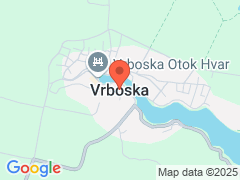
The church is located just above the historic part of the town and is very easy to include in a walk around Vrboska.
It can be reached in a few minutes from the waterfront and bridges through the old core. The church of St. Lawrence is also nearby, making it best to visit both landmarks in the same tour.
A car is not necessary for moving between the main attractions of Vrboska.
Parking
The church does not have its own parking area for visitors.
There are public parking areas near the old core, after which visitors continue on foot to the church. During the main summer season, the number of available spaces in the central part of Vrboska can be limited, so it is more practical to leave the car at the first suitable public parking and explore the center on foot.
Why Is It Worth Visiting?
If you have time in Vrboska to see only one historical landmark, the Church-Fortress of St. Mary of Mercy should be among your top choices.
It is interesting not only because of its age but also because it encapsulates almost the entire story of old Vrboska in one place: life by the sea, Ottoman attacks, the need for defense, the faith of the local population, Renaissance art, and the tradition of the procession Za Križen.
Useful Information
- Type of Landmark: Fortified historical church
- Original Construction: Second half of the 15th century
- Original Style: Gothic single-nave church with a rectangular apse
- Attack on Vrboska: The church was damaged during the Ottoman attack in 1571
- Fortification: Expanded and fortified in 1575
- Purpose of the Fortification: Protection and shelter for the population of Vrboska during attacks
- Interior: Can be visited when the church is open to visitors
- Artworks: Some valuable Renaissance artworks have been relocated to St. Lawrence's Church due to humidity
- Upper Parts of the Fortress: Access to defensive parts is possible during tourist visits, with a nice view of Vrboska
- Procession Za Križen: The church-fortress is one of the important sacred points in the procession in Vrboska
- Distance from the Waterfront: A few minutes' walk
- Church of St. Lawrence: Located very close and worth visiting in the same tour
- Parking: No dedicated parking; use public parking in the wider center of Vrboska
- Time for Visit: Approximately 20 to 40 minutes, longer if exploring the upper parts
- Best for: History, architecture, sacred heritage, and panoramic views enthusiasts


Fortress Church of St. Mary of Mercy / Comments
Looks like you are not signed in!
How would you like to proceed?
Anonymous comment
Login
Register
Your comment was submitted successfully and it will be published after approval by administrator!
General Conditions of Publication
General Conditions of Publiciation
1. Web page
Web page www.holiday-link.com is an interactive web page where the visitors can put texts, news, photos and video movies regarding the content about tourism, gastronomy, culture and entertainment. Information can be uploaded by the owners, managers, employees, tourist boards, residents and tourists, basically all those who want to introduce the public to the specific content (facilities). The site allows evaluation of the attractiveness of a specific content and it allows writing comments by other visitors. Visitors, who log in and want to publish an information about some content (facility) or promote some tourist service, become users or suppliers and they agree to the general terms and conditions that are stipulated here and are obliged to act in accordance with the general terms and conditions (general conditions do not apply if a person is only visiting the page). A person can become a user by signing up with a user name and a password. The user agrees to put the accurate access data, name and surname and the address. Contents that users publish will be signed with a nickname they choose, while the personal data will be used in accordance with the privacy statement. Persons under the age of thirteen are not allowed to enter any content. General terms can be changed from time to time and if the user or supplier doesn’t agree with the changed general terms and conditions he can remove his content from the site.
2. Content
The page is not the media that publishes editorial program contents but the page where the visitors publish information that serve for the educational and cultural public informing about the touristic, cultural and gastronomic contents (facilities). The goal of the site is to collect the information that will give the tourists, as well as the locals, the insight into touristic, cultural and gastronomic offer of the certain location (city, region and country). Publishing the information about the content (information on facilities) is completely free of charge. Except the touristic content , on these pages, providers of various services in tourism may publish and advertise services they offer. These are, further in the text, referred to as a suppliers. Users and suppliers are solely responsible for the publication of their contents in accordance with the statement of responsibility.
3. User obligations
Each user is obliged to use the website in accordance with the general terms and conditions. By publishing the certain text, comment, photo or video movie on the site, the user guarantees that the published information are true, and that they are not copyrighted by a third party. Each user is morally and materially responsible for the publication of content. It is forbidden to copy texts from other websites. Administrators review entered contents and approve them for publishing. Holiday-Link.com has the right not to show the content it finds inappropriate, untrue or offensive. The owners, managers or employees of the gastronomic facilities (eg. restaurants) have the right to reply to the articles and comments on their own content. The owners have the right to request the removal of the text regarding their facilities if they find it inappropriate. The complaint can be send to complain@holiday-link.com. By publishing the content, the user is giving the exclusive, royalty-free, perpetual transferable, irrevocable and fully sublicensable licence (copyright) to use, reproduce modify, adapt, translate, distribute, publish and publicly display subscribed content to the Holiday-Link.com and its affiliates.
4. The obligations of suppliers of tourist services (accommodation and other services)
Company Holiday-Link.com Ltd acts as advertising website on this website and not as a tour operator or intermediary travel agency. Suppliers of tourist services who register their capacity on this site, pay the commercial advertising model they choose. Interaction, regarding arranging a specific accommodation or other tourist service, is done directly between supplier and visitor. Visitors arrange the accommodation or some other touristic service directly with the suppliers and pay the arranged service to them. Suppliers are responsible for all entered data, images, prices and more. Suppliers guarantee that they have all licences necessary to carry out the services they offer, and to operate in accordance with the laws of their home country. By purchasing certain service, visitor accepts the terms and conditions of a supplier from whom he purchased the service. Holiday-Link will check each supplier before putting its facilities to be visible on the page.
5. Statement of Responsibility
The information, that users and suppliers are entering, can be wrong. Holiday-Link.com does not check the entry of the information, pictures and movies and cannot guarantee their accuracy and it disclaims any responsibility for any incorrect data. If you notice a certain misstatement, inaccuracy or inadequacy in any content, please contact us by e-mail: complain@holiday-link.com The responsibility, for every information about some content, is on the user who entered the information. Suppliers, who advertise touristic services via this website, act as independent entrepreneurs. They enter the data about their services , as well as the pictures and the prices, on their own. Holiday-Link.com does not check entered data and disclaims responsibility regarding the errors that can occur during the entering. Suppliers have to own all the licences regarding the services they offer, and they have to respect the laws and regulations of the home country. Visitor arranges the specific service directly with the supplier, on the basis of data that is entered by a supplier as independent entrepreneur, and he pays it directly to the supplier. Therefore, Holiday-Link.com disclaims responsibility for any problem related to the certain reservation.
6. Privacy Policy
When logging into the website, users and suppliers have to enter some personal data (name and surname, e-mail, address, phone number, etc.). Holiday-Link.com guarantees that this data will be kept secret and will not be forwarded to the third parties. Holiday-Link.com can use an user and a supplier e-mail for sending necessarry informaion and for advertising.
7. Cookie Policy
Cookies are small text files that can be stored into device of a visitor if it is allowed by a web browser. Holiday-Link.com uses cookies to provide a better user experience on the website for the visitors. Also, while visiting Holiday-Link.com, you can automatically collect a certain data.
8. Court Jurisdiction
In case of any dispute, related to the site holiday-link.com, the court in Split and the Croatian law are competent.