St. Lawrence Church, Vrboska – the Parish Church with the Most Valuable Collection of Art on Hvar Island
St. Lawrence Church is one of the most significant landmarks in Vrboska. From the outside, it appears quite simple and unobtrusive, but behind its stone façade lies an exceptionally rich collection of paintings and sacred art, making this parish church one of the most valuable places for art enthusiasts on the entire island of Hvar.
It is located in the old part of Vrboska, just a few minutes' walk from the fortress church of St. Mary of Mercy. These two churches are best visited together: St. Mary impresses with its fortification architecture, while St. Lawrence holds the greatest surprise within its interior.
A 15th-Century Church
St. Lawrence Church dates back to the 15th century, a period when Vrboska began to develop as a fishing and maritime settlement.
Its history has not been peaceful. The church was damaged in a fire in 1512 during the Hvar Uprising and was again burned in 1571 during an Ottoman attack that severely affected Vrboska and much of the island.
The current appearance is the result of later restorations, and in the 17th century, the church was remodelled in the Baroque style, which it has largely retained to this day.
Five Altars and an Exceptionally Rich Interior
The church has five altars, but what sets it apart from most smaller island parish churches is the quantity and quality of the artworks it houses.
For centuries, Vrboska has been a strong fishing and trading hub. Thanks to the income from fishing and trade, local brotherhoods and residents were able to commission valuable works from renowned artists.
Thus, the modest stone exterior of the church conceals an interior that many visitors do not expect.
The Polyptych of St. Lawrence on the Main Altar
The most important artwork is located on the main altar.
The central depiction is dedicated to St. Lawrence with the Virgin Mary, accompanied by St. John the Baptist and St. Nicholas. Other scenes illustrate events from the life and martyrdom of St. Lawrence.
The polyptych is associated with the great Venetian Renaissance painter Paolo Veronese. This work is one of the main reasons why St. Lawrence Church stands out in the sacred heritage of Hvar.
Works by Great Masters
The main altar is just the beginning.
On the side altars and walls, one can find works by artists representing several centuries of European and Croatian sacred art.
Notable works are linked to names such as Jacopo da Ponte Bassano, Antonio Sciuri, Stefano Celesti, and Giuseppe Alabardi, as well as important Croatian painters from the early 20th century Celestin Medović and Marko Rašica.
The ceilings also feature 18th-century paintings depicting God the Father, the Son, and the Coronation of Mary.
For all these reasons, the church cannot be appreciated merely from the outside – its true value is revealed only upon entering.
Artworks from the Fortress Church of St. Mary
Today, St. Lawrence Church also houses part of the artistic treasure that was once located in the nearby fortress church of St. Mary of Mercy.
Due to moisture issues in the fortress, valuable works were relocated to the safer environment of the parish church.
Here, there is also a statue of St. Peter that originally belonged to the chapel of St. Peter, associated with the great Renaissance sculptor Nikola Firentinac.
Thus, St. Lawrence now functions almost as a small gallery of sacred art in Vrboska.
St. Lawrence – the Patron of Vrboska
St. Lawrence is the patron saint of Vrboska, and his feast day is celebrated on 10th August.
On this day, the place comes alive, with a religious celebration accompanied by a procession and a traditional summer festival. For visitors in Vrboska at the beginning of August, this is one of the best times to experience local traditions.
The church is not only a historical landmark but also remains a vibrant centre of the parish.
St. Lawrence Church and the Za križen Procession
St. Lawrence Church plays an important role in the Za križen procession, a centuries-old Hvar tradition inscribed on UNESCO's Representative List of the Intangible Cultural Heritage of Humanity.
On the night of Maundy Thursday to Good Friday, six processions set off simultaneously from Vrboska, Jelsa, Pitava, Vrisnik, Svirče, and Vrbanja.
The Vrboska procession begins at its parish church of St. Lawrence, and after a night walk of approximately 25 kilometres, the cross-bearers and procession return to the same church by morning.
This makes St. Lawrence one of the most important places of living religious tradition in Vrboska.
Can the church be visited inside?
Yes, St. Lawrence Church can be visited inside.
During the tourist season, there are specific times when it is open to visitors, but it is not a site that is continuously open from morning until evening.
Outside of visiting hours, the church may be locked, except during masses and other church events.
If you wish to see the art collection, it is advisable to plan your visit during the times when the interior is open.
Location in Vrboska
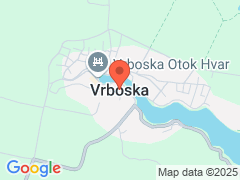
The church is situated in the historic part of the town, very close to the waterfront and main attractions.
It takes only a few minutes to walk from the fortress church of St. Mary of Mercy to St. Lawrence, so there is no reason to visit these two locations separately.
Nearby are also the Fishing Museum, bridges over the narrow sea channel, and the old stone core of Vrboska.
Parking
The church does not have its own parking for visitors.
It is best to leave your car in a public parking area in the wider centre of Vrboska and continue on foot. The old town is small, so almost all main attractions can be visited without needing to use the car again.
During July and August, finding a free spot in the very centre can be more challenging, especially in the evenings.
Why is it worth entering?
St. Lawrence Church is one of those landmarks that can easily be underestimated if viewed only from the outside.
The simple stone building conceals an exceptionally rich artistic collection, from Renaissance and Baroque masters to Croatian painters of the early 20th century.
If the fortress church of St. Mary represents the military and architectural history of Vrboska, St. Lawrence best illustrates how the once small fishing village was connected to the culture and art of a much broader Mediterranean area.
Useful Information
- Type of landmark: parish church and collection of sacred art
- Period of origin: 15th century
- Current style: predominantly Baroque appearance after the 17th-century renovation
- Historical damages: the church was burned in 1512 and again in 1571
- Number of altars: five
- Most important work: the polyptych of St. Lawrence on the main altar, associated with Paolo Veronese
- Other artists: Jacopo da Ponte Bassano, Antonio Sciuri, Stefano Celesti, Giuseppe Alabardi, Celestin Medović, Marko Rašica, and others
- Additional collection: the church houses part of the artworks relocated from the fortress church of St. Mary due to moisture
- Patron of Vrboska: St. Lawrence
- Feast of St. Lawrence: 10th August
- Za križen procession: the procession from Vrboska starts at the parish church of St. Lawrence and returns to it after the night walk
- Interior visits: possible when the church is open to visitors; not open continuously throughout the day
- Distance from the fortress church of St. Mary: a few minutes' walk
- Parking: no private parking; use public parking in the wider centre of Vrboska
- Time for a visit: around 20 to 30 minutes
- Best for: art lovers, history enthusiasts, sacred heritage, and local traditions


Church of St. Lawrence / Comments
Looks like you are not signed in!
How would you like to proceed?
Anonymous comment
Login
Register
Your comment was submitted successfully and it will be published after approval by administrator!
General Conditions of Publiciation
General terms and conditions and notes
1. Web page
Web page www.holiday-link.com is an interactive web page where the visitors can put texts, news, photos and video movies regarding the content about tourism, gastronomy, culture and entertainment. Information can be uploaded by the owners, managers, employees, tourist boards, residents and tourists, basically all those who want to introduce the public to the specific content (facilities). The site allows evaluation of the attractiveness of a specific content and it allows writing comments by other visitors. Visitors, who log in and want to publish an information about some content (facility) or promote some tourist service, become users or suppliers and they agree to the general terms and conditions that are stipulated here and are obliged to act in accordance with the general terms and conditions (general conditions do not apply if a person is only visiting the page). A person can become a user by signing up with a user name and a password. The user agrees to put the accurate access data, name and surname and the address. Contents that users publish will be signed with a nickname they choose, while the personal data will be used in accordance with the privacy statement. Persons under the age of thirteen are not allowed to enter any content. General terms can be changed from time to time and if the user or supplier doesn’t agree with the changed general terms and conditions he can remove his content from the site.
2. Content
The page is not the media that publishes editorial program contents but the page where the visitors publish information that serve for the educational and cultural public informing about the touristic, cultural and gastronomic contents (facilities). The goal of the site is to collect the information that will give the tourists, as well as the locals, the insight into touristic, cultural and gastronomic offer of the certain location (city, region and country). Publishing the information about the content (information on facilities) is completely free of charge. Except the touristic content , on these pages, providers of various services in tourism may publish and advertise services they offer. These are, further in the text, referred to as a suppliers. Users and suppliers are solely responsible for the publication of their contents in accordance with the statement of responsibility.
3. User obligations
Each user is obliged to use the website in accordance with the general terms and conditions. By publishing the certain text, comment, photo or video movie on the site, the user guarantees that the published information are true, and that they are not copyrighted by a third party. Each user is morally and materially responsible for the publication of content. It is forbidden to copy texts from other websites. Administrators review entered contents and approve them for publishing. Holiday-Link.com has the right not to show the content it finds inappropriate, untrue or offensive. The owners, managers or employees of the gastronomic facilities (eg. restaurants) have the right to reply to the articles and comments on their own content. The owners have the right to request the removal of the text regarding their facilities if they find it inappropriate. The complaint can be send to complain@holiday-link.com. By publishing the content, the user is giving the exclusive, royalty-free, perpetual transferable, irrevocable and fully sublicensable licence (copyright) to use, reproduce modify, adapt, translate, distribute, publish and publicly display subscribed content to the Holiday-Link.com and its affiliates.
4. The obligations of suppliers of tourist services (accommodation and other services)
Company Holiday-Link.com Ltd acts as advertising website on this website and not as a tour operator or intermediary travel agency. Suppliers of tourist services who register their capacity on this site, pay the commercial advertising model they choose. Interaction, regarding arranging a specific accommodation or other tourist service, is done directly between supplier and visitor. Visitors arrange the accommodation or some other touristic service directly with the suppliers and pay the arranged service to them. Suppliers are responsible for all entered data, images, prices and more. Suppliers guarantee that they have all licences necessary to carry out the services they offer, and to operate in accordance with the laws of their home country. By purchasing certain service, visitor accepts the terms and conditions of a supplier from whom he purchased the service. Holiday-Link will check each supplier before putting its facilities to be visible on the page.
5. Statement of Responsibility
The information, that users and suppliers are entering, can be wrong. Holiday-Link.com does not check the entry of the information, pictures and movies and cannot guarantee their accuracy and it disclaims any responsibility for any incorrect data. If you notice a certain misstatement, inaccuracy or inadequacy in any content, please contact us by e-mail: complain@holiday-link.com The responsibility, for every information about some content, is on the user who entered the information. Suppliers, who advertise touristic services via this website, act as independent entrepreneurs. They enter the data about their services , as well as the pictures and the prices, on their own. Holiday-Link.com does not check entered data and disclaims responsibility regarding the errors that can occur during the entering. Suppliers have to own all the licences regarding the services they offer, and they have to respect the laws and regulations of the home country. Visitor arranges the specific service directly with the supplier, on the basis of data that is entered by a supplier as independent entrepreneur, and he pays it directly to the supplier. Therefore, Holiday-Link.com disclaims responsibility for any problem related to the certain reservation.
6. Privacy Policy
When logging into the website, users and suppliers have to enter some personal data (name and surname, e-mail, address, phone number, etc.). Holiday-Link.com guarantees that this data will be kept secret and will not be forwarded to the third parties. Holiday-Link.com can use an user and a supplier e-mail for sending necessarry informaion and for advertising.
7. Cookie Policy
Cookies are small text files that can be stored into device of a visitor if it is allowed by a web browser. Holiday-Link.com uses cookies to provide a better user experience on the website for the visitors. Also, while visiting Holiday-Link.com, you can automatically collect a certain data.
8. Court Jurisdiction
In case of any dispute, related to the site holiday-link.com, the court in Split and the Croatian law are competent.