St Stephen the First Martyr Church in Grohote – The Sacred Centre of Šolta
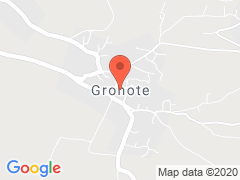
St Stephen the First Martyr Church is located in the old part of Grohote, the largest and historically most significant settlement on the island of Šolta. The tall stone bell tower is visible from various parts of the village, making the church not only a parish centre but also one of its main landmarks.
The current structure is designed in a neo-Renaissance style. It differs from the traditional smaller island churches in its size, well-carved stone façades, and tall square bell tower with openings for the bells and a clock. The red roofs, stone walls, and tall trees surrounding the church create one of the more recognisable scenes in the interior of Šolta.
The historical significance of this site predates the current church by many centuries. Adjacent to its northern wall are the remains of an early Christian basilica dating back to the 5th century. It is believed that the basilica was in use until the Middle Ages when it was destroyed and burned during one of the pirate raids on Šolta.
Preserved from the old basilica are the foundations and parts of the floor mosaic. These remains are not arranged as a large enclosed archaeological museum but are located next to the church and the old local cemetery, making them best viewed during a peaceful stroll around the church grounds.
The cemetery also features old stone sarcophagi, further confirming the long continuity of life and burial at this site. The entire area surrounding the church thus represents a blend of sacred architecture, archaeological remains, and the history of Grohote from late antiquity to the present day.
Inside the church, there is a valuable collection of sacred artefacts registered in the Cultural Heritage Register of the Republic of Croatia. Visitors to the church are advised to pay attention to the altars, paintings, sculptures, and other liturgical items, but photography should be conducted in accordance with the parish rules and the flow of the service.
St Stephen the First Martyr is the patron saint of Grohote, and his brotherhood has played an important role in the life of the village for centuries. Close to the church is the Brotherhood House, once the seat of the brotherhood where wine, olive oil, and other communal goods were stored. Today, this restored complex houses cultural and tourist facilities.
Adjacent to the church is the old local cemetery, where Vesna Parun, one of the most significant Croatian poets of the 20th century, is buried. Her grave is simple and integrated into the tranquil space of the old cemetery, without a separate memorial complex.
The church does not have standard tourist opening hours like a museum. It is most likely to be open just before and after mass, during Sunday services, holidays, and local celebrations. When the doors are closed, it is possible to view the exterior, the bell tower, the remains of the basilica, and the cemetery.
Visitors should respect the fact that this is an active parish church and cemetery. During mass, it is inappropriate to walk around inside, speak loudly, or photograph worshippers, while in the cemetery, one should move quietly and remain on the paths.
The church can be reached on foot from the centre of Grohote in just a few minutes. It is situated in the older part of the settlement, not far from the Slavić Tower, Brotherhood House, and the Buktenica & Buktenica Gallery, allowing for a short walk connecting all these landmarks.
From the ferry port in Rogač, Grohote is approximately one and a half kilometres away. By car, it takes just a few minutes, and the village is also connected by the island bus. From the main bus stop, it is a short walk through the settlement to the church.
There is no large parking area for visitors directly next to the church. The streets in the old part of Grohote are occasionally narrow, so it is best to leave the vehicle in a permitted space along the wider road and walk the last few minutes. During masses, funerals, and major holidays, surrounding areas can fill up quickly.
The area around the church is mostly accessible on foot, but the stone and occasionally uneven surface may pose difficulties for those with reduced mobility. It is advisable to check in advance for a more suitable access route for entering the church and accessing the archaeological remains.
St Stephen's Church is worth visiting even when the interior is closed. In a small space, one can see the neo-Renaissance parish church, the remains of the early Christian basilica, mosaics, stone sarcophagi, and the old cemetery. There are few places on Šolta where the history of the island from late antiquity to contemporary life can be so clearly traced.


Church of St. Stephen / Comments
Looks like you are not signed in!
How would you like to proceed?
Anonymous comment
Login
Register
Your comment was submitted successfully and it will be published after approval by administrator!
General Conditions of Publiciation
General terms and conditions and notes
1. Web page
Web page www.holiday-link.com is an interactive web page where the visitors can put texts, news, photos and video movies regarding the content about tourism, gastronomy, culture and entertainment. Information can be uploaded by the owners, managers, employees, tourist boards, residents and tourists, basically all those who want to introduce the public to the specific content (facilities). The site allows evaluation of the attractiveness of a specific content and it allows writing comments by other visitors. Visitors, who log in and want to publish an information about some content (facility) or promote some tourist service, become users or suppliers and they agree to the general terms and conditions that are stipulated here and are obliged to act in accordance with the general terms and conditions (general conditions do not apply if a person is only visiting the page). A person can become a user by signing up with a user name and a password. The user agrees to put the accurate access data, name and surname and the address. Contents that users publish will be signed with a nickname they choose, while the personal data will be used in accordance with the privacy statement. Persons under the age of thirteen are not allowed to enter any content. General terms can be changed from time to time and if the user or supplier doesn’t agree with the changed general terms and conditions he can remove his content from the site.
2. Content
The page is not the media that publishes editorial program contents but the page where the visitors publish information that serve for the educational and cultural public informing about the touristic, cultural and gastronomic contents (facilities). The goal of the site is to collect the information that will give the tourists, as well as the locals, the insight into touristic, cultural and gastronomic offer of the certain location (city, region and country). Publishing the information about the content (information on facilities) is completely free of charge. Except the touristic content , on these pages, providers of various services in tourism may publish and advertise services they offer. These are, further in the text, referred to as a suppliers. Users and suppliers are solely responsible for the publication of their contents in accordance with the statement of responsibility.
3. User obligations
Each user is obliged to use the website in accordance with the general terms and conditions. By publishing the certain text, comment, photo or video movie on the site, the user guarantees that the published information are true, and that they are not copyrighted by a third party. Each user is morally and materially responsible for the publication of content. It is forbidden to copy texts from other websites. Administrators review entered contents and approve them for publishing. Holiday-Link.com has the right not to show the content it finds inappropriate, untrue or offensive. The owners, managers or employees of the gastronomic facilities (eg. restaurants) have the right to reply to the articles and comments on their own content. The owners have the right to request the removal of the text regarding their facilities if they find it inappropriate. The complaint can be send to complain@holiday-link.com. By publishing the content, the user is giving the exclusive, royalty-free, perpetual transferable, irrevocable and fully sublicensable licence (copyright) to use, reproduce modify, adapt, translate, distribute, publish and publicly display subscribed content to the Holiday-Link.com and its affiliates.
4. The obligations of suppliers of tourist services (accommodation and other services)
Company Holiday-Link.com Ltd acts as advertising website on this website and not as a tour operator or intermediary travel agency. Suppliers of tourist services who register their capacity on this site, pay the commercial advertising model they choose. Interaction, regarding arranging a specific accommodation or other tourist service, is done directly between supplier and visitor. Visitors arrange the accommodation or some other touristic service directly with the suppliers and pay the arranged service to them. Suppliers are responsible for all entered data, images, prices and more. Suppliers guarantee that they have all licences necessary to carry out the services they offer, and to operate in accordance with the laws of their home country. By purchasing certain service, visitor accepts the terms and conditions of a supplier from whom he purchased the service. Holiday-Link will check each supplier before putting its facilities to be visible on the page.
5. Statement of Responsibility
The information, that users and suppliers are entering, can be wrong. Holiday-Link.com does not check the entry of the information, pictures and movies and cannot guarantee their accuracy and it disclaims any responsibility for any incorrect data. If you notice a certain misstatement, inaccuracy or inadequacy in any content, please contact us by e-mail: complain@holiday-link.com The responsibility, for every information about some content, is on the user who entered the information. Suppliers, who advertise touristic services via this website, act as independent entrepreneurs. They enter the data about their services , as well as the pictures and the prices, on their own. Holiday-Link.com does not check entered data and disclaims responsibility regarding the errors that can occur during the entering. Suppliers have to own all the licences regarding the services they offer, and they have to respect the laws and regulations of the home country. Visitor arranges the specific service directly with the supplier, on the basis of data that is entered by a supplier as independent entrepreneur, and he pays it directly to the supplier. Therefore, Holiday-Link.com disclaims responsibility for any problem related to the certain reservation.
6. Privacy Policy
When logging into the website, users and suppliers have to enter some personal data (name and surname, e-mail, address, phone number, etc.). Holiday-Link.com guarantees that this data will be kept secret and will not be forwarded to the third parties. Holiday-Link.com can use an user and a supplier e-mail for sending necessarry informaion and for advertising.
7. Cookie Policy
Cookies are small text files that can be stored into device of a visitor if it is allowed by a web browser. Holiday-Link.com uses cookies to provide a better user experience on the website for the visitors. Also, while visiting Holiday-Link.com, you can automatically collect a certain data.
8. Court Jurisdiction
In case of any dispute, related to the site holiday-link.com, the court in Split and the Croatian law are competent.