St. Mark's Church in Hvar – Remnants of the Dominican Monastery, Renaissance Bell Tower, and a Site of Significant Events in Hvar's History
St. Mark's Church in the town of Hvar is one of the most significant historical landmarks, revealing the layered past of the island. Located in the old part of the town known as Sveti Marak, this former Dominican church is first mentioned in the early 14th century. Although much of the building was lost following the dissolution of the monastery in the 19th century, the preserved walls, stone tombs, and particularly the lavish Renaissance bell tower testify to its former importance. The church served as a meeting place for the Grand Council of the Hvar Commune, and in 1525, the Dominican Vinko Pribojević delivered his famous speech on the origins and glory of the Slavs. The site's value is further enhanced by its connection to the Archaeological Collection and Lapidarium "Dr. Grga Novak", while the restoration project of the former monastery complex opens a new chapter in preserving Hvar's cultural heritage.
St. Mark's Church – A Historical Monument Above Hvar's Waterfront
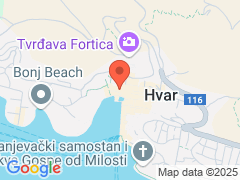
St. Mark's Church is situated in the western part of Hvar's historic core, on a gentle rise not far from the main town square and harbour.
Its tall stone bell tower is one of the most recognisable features of Hvar's skyline, particularly striking when viewed from the sea, the harbour, or from the Fortica fortress.
Although listed as a church on Google Maps, it is no longer a preserved place of worship where regular services are held, but rather the remains of the former Dominican church and monastery.
Most of the church's interior is roofless, with preserved sections of walls, the former sanctuary, and the monumental bell tower.
This combination of preserved architecture and open space makes St. Mark's unique compared to other churches in Hvar.
The site is significant not only for its sacred history but also for its connections to the political life of the medieval Hvar Commune, Renaissance literature, and archaeological research on the island.
The History of the Dominican Monastery and St. Mark's Church
The Dominican monastery and St. Mark's Church are first mentioned in 1312, at a time when Hvar was already a significant maritime, trading, and administrative centre on the eastern Adriatic coast.
The Dominican order, known for its preaching, education, and theological tradition, played an important role in the cultural life of medieval Dalmatian towns.
The dedication to St. Mark is particularly interesting as it was not common for Dominican monasteries, linking it to the patronage of Venice, whose protector is St. Mark the Evangelist.
Over the centuries, the church has been expanded and renovated multiple times.
Its current remains primarily date from the 16th and 17th centuries, when the original structure took on a more developed form.
At its peak, it was a three-nave church with multiple altars, a rich artistic inventory, and tombs of prominent Hvar families.
In 1579, seven altars were recorded within it, indicating how important and richly furnished the monastic church was.
The Dominican monastery was dissolved in the early 19th century during the French administration of Dalmatia.
Following its dissolution, much of the complex was demolished or repurposed, and the church's artworks were transferred to other sacred buildings on the island.
Today, the valuable architectural monument that remains preserves the memory of over five centuries of Dominican presence in Hvar.
A Meeting Place for the Grand Council of the Hvar Commune
St. Mark's Church did not serve solely religious purposes.
During the 14th and 15th centuries, it was the meeting place for the Grand Council of the Hvar Commune, a body in which representatives of the town's nobility participated in the governance of the commune.
In medieval Hvar, church and public life were closely intertwined. Large monastic churches provided ample space for gatherings, ceremonies, and important decision-making.
The council meetings held in St. Mark's Church illustrate its significance in the political system of the time.
The Hvar Commune encompassed a wide island area, and its administration evolved over the centuries under the influence of local nobility and the Venetian Republic.
The fact that this church was one of the gathering places for city councillors gives it particular significance in Hvar's history.
It was not only part of monastic life but also a space where issues important to the functioning of the island community were discussed.
Vinko Pribojević and the Notable Speech of 1525
One of the most important events associated with St. Mark's Church occurred in 1525.
At that time, the Hvar Dominican and humanist Vinko Pribojević delivered his famous speech On the Origins and Glory of the Slavs, also known by its Latin title De origine successibusque Slavorum.
Pribojević belonged to the intellectual circle of Renaissance humanism and aimed to reflect on the history and cultural significance of the Slavic peoples in his speech.
His work is one of the important achievements of Croatian Renaissance historiography and the early formation of the idea of a common Slavic origin.
The speech is particularly interesting as it provides information about the history of Hvar, the island, and its inhabitants.
It was later published in Venice, making it accessible to a much wider audience.
The connection of St. Mark's with Vinko Pribojević gives this site a special place in Croatian cultural and literary history.
There are few Hvar buildings that can be linked to such an important intellectual event from the Renaissance period.
The Renaissance Bell Tower – One of the Most Beautiful in Hvar
The most famous and best-preserved part of the former St. Mark's Church is its monumental Renaissance bell tower.
Constructed in the second half of the 16th century, its design is associated with the renowned Bokanić workshop.
The bell tower is distinguished by its slender proportions, rich stone detailing, and harmonious arrangement of architectural elements.
On the upper levels, there are bifora and trifora windows, which are openings divided by small columns into two or three parts.
Its distinctive feature is the open octagonal loggia topped with a pyramidal roof.
Unlike bell towers with domed tops, the pyramidal peak emphasises its verticality and elegant appearance.
With its proportions and decorations, it is one of the most important examples of Renaissance sacred architecture in the town of Hvar.
Its relationship with the bell towers of the Hvar Cathedral and the Franciscan Monastery is also interesting, as they form a recognisable group of historical towers in the town's skyline.
Restoration of the Bell Tower Following a Lightning Strike
The current appearance of the bell tower is also the result of an important restoration in the 19th century.
The upper part was damaged by a lightning strike, necessitating the reconstruction of the building's top section.
The restoration was carried out in 1894 according to the design of architect Alois Hauser.
During the reconstruction, efforts were made to preserve the original proportions and Renaissance appearance of the bell tower, including its characteristic pyramidal top.
Thanks to this intervention, the bell tower has retained its distinctive shape and remains one of Hvar's visual symbols.
Its importance is particularly evident when the town is viewed from elevated positions, where the relationship between the cathedral, the Franciscan Monastery, and St. Mark's can be clearly seen.
Tombs of Hvar's Noble Families
Within the former church, there are numerous historical grave slabs.
These date from the 15th to the 18th centuries and belonged to prominent Hvar families.
Many are adorned with coats of arms, inscriptions, and stone reliefs that testify to the social status of the deceased and the tradition of burial in church spaces.
Particularly interesting is the grave of Antun Lucić, son of the famous Hvar Renaissance poet Hanibal Lucić.
In the space of the former church, there is also the grave of Hvar composer Josip Raffaelli, who lived from 1767 to 1843.
The grave slabs today represent a valuable source for studying the history of Hvar families, heraldry, and stone carving art.
Their arrangement also provides clues about earlier phases of construction.
The position of the oldest graves indicates that the church was smaller in the 15th century than in later periods, prior to its expansion during the 16th and 17th centuries.
The Archaeological Collection and Lapidarium "Dr. Grga Novak"
The area of the former Dominican church is also connected to one of the most important museum collections on the island of Hvar.
The Archaeological Collection and Lapidarium "Dr. Grga Novak" was established in 1966 as part of the Hvar Heritage Museum.
It is named after Grga Novak, a notable Croatian historian and archaeologist born in Hvar in 1888.
Novak was among the first to systematically research prehistoric sites on the island, including Grapčeva and Markova caves.
The Archaeological Collection encompasses items that testify to life on Hvar from prehistory to late antiquity.
Among the items are ceramic vessels, stone and bone tools, obsidian fragments, ancient coins, oil lamps, amphorae, and remnants of ship equipment.
The lapidarium includes stone monuments, reliefs, coats of arms, inscriptions, and architectural fragments from various periods of Hvar's history.
Particularly valuable are the Renaissance grave slabs with coats of arms of former noble families.
The collection was historically located in part of the former apse, with stone monuments arranged within the open space of the church.
Due to the restoration and reconstruction project, the museum space is not available as a regular permanent exhibition. Nevertheless, the history of the collection remains an important part of St. Mark's identity.
Sveti Marak – The Historical Quarter of Hvar
The area around the church is known as Sveti Marak, named after the former Dominican monastery.
This is a part of the old town core located slightly above the coastal promenade.
The narrow streets, stone houses, and ancient walls have retained the distinctive appearance of a traditional Dalmatian town.
In contrast to the open and busy waterfront, this area offers a quieter atmosphere and interesting views of the historical architecture.
The St. Mark's bell tower dominates the surroundings and is an important landmark during a walk through the western part of the old town.
Due to its height and position, it is easily recognisable from various locations in the town.
In the immediate vicinity, there are also other historical elements of the former monastic complex, including stone walls and traces of earlier construction phases.
Restoration of St. Mark's Church and Future Museum
The former St. Mark's monastery complex has recently become the subject of an extensive restoration and revitalisation project.
The project aims to preserve the historical remains of the church and to construct and arrange a modern space for the Hvar Heritage Museum.
The goal is to connect the old architecture with new museum contents, enabling a better presentation of archaeological and cultural-historical material, and to reactivate one of the important spaces in the historic core.
The planned concept pays special attention to preserving the original stone walls, the bell tower, and the former church space.
The project also includes the possibility of a new interpretation of the complex as a venue for exhibitions and cultural events.
Restoration work on the complex began in February 2026.
Due to these interventions, the space cannot be viewed as a permanently open tourist attraction with regular access to the interior.
Regardless of the restoration, the bell tower and preserved parts of the building remain an important part of Hvar's historical panorama.
How to Reach St. Mark's Church?
St. Mark's Church is located in the western part of Hvar's historic core, not far from the town's waterfront.
The simplest way to reach it is on foot.
From St. Stephen's Square, head towards the western part of the old town and continue along the stone streets towards the recognisable bell tower.
The walk from the centre takes approximately five to ten minutes, depending on your starting point.
The route includes a short ascent and stone streets with steps, so comfortable footwear is recommended.
It is not possible to access the building directly by car as a typical tourist site since it is located within the historical urban area.
Visitors arriving by car can use public parking outside the pedestrian zone and continue on foot.
During construction work or organised events, some access routes may be restricted.
What Else to Visit Nearby?
The location of St. Mark's Church allows for easy connections to other important Hvar attractions.
On the main town square, you will find St. Stephen's Cathedral, one of the most important sacred buildings on the island.
Adjacent to the square is the Arsenal with the Hvar Theatre, established in 1612, which holds a special place in the history of European public theatre.
Nearby are the town loggia and the clock tower Leroj, remnants of the former administrative centre of Hvar.
The town's waterfront is an interesting place for a stroll, offering views towards the Pakleni Islands.
Above the old town rises the Fortica fortress, from which the St. Mark's bell tower can be particularly well seen among the stone houses and red roofs of the town.
Exploring these landmarks provides a comprehensive view of Hvar's history, from its medieval political life to Renaissance art and contemporary culture.
Why Visit St. Mark's Church in Hvar?
St. Mark's Church is one of the historically most interesting buildings in the town of Hvar, even though it is only partially preserved today.
Its significance far exceeds that of sacred architecture.
It was here that members of the Grand Council of the Hvar Commune gathered, and in 1525, Vinko Pribojević delivered a speech that left a significant mark on Croatian Renaissance culture.
The preserved Renaissance bell tower is among the most beautiful architectural details in the town, while the grave slabs, stone reliefs, and the history of the archaeological collection reveal the richness of Hvar's past.
The restoration project further confirms the value of this site for the future of the island's cultural heritage.
Even when the interior is not accessible for viewing, St. Mark's Church remains a landmark worth exploring during a walk through the old part of Hvar, especially due to its bell tower and intriguing historical narrative.
Useful Information
- Type of attraction: Remains of a historical Dominican church and monastery
- First written mention of the complex: 1312
- Period of preserved remains: Mainly 16th and 17th centuries
- Architectural feature: Monumental Renaissance bell tower with bifora, trifora, and pyramidal top
- Restoration of the bell tower: 1894, according to the design of Alois Hauser
- Historical significance: Former meeting place of the Grand Council of the Hvar Commune
- Notable event: Vinko Pribojević's speech on the origins and glory of the Slavs in 1525
- Historical monuments: Grave slabs and coats of arms of Hvar families from the 15th to 18th centuries
- Museum heritage: Historical space of the Archaeological Collection and Lapidarium "Dr. Grga Novak"
- Status: Cultural heritage in the process of restoration and revitalisation
- Viewing: Exterior appearance and bell tower; access to the interior depends on the progress of works
- Access: On foot via stone streets of the old town, with a short ascent
- Parking: Public parking outside the historical pedestrian zone
- Nearby: St. Stephen's Cathedral, Arsenal, Hvar Theatre, town loggia, and Fortica fortress
- Recommended for: History enthusiasts, lovers of Renaissance architecture, archaeology, and cultural heritage


Crkva Sv. Marka / Comments
Looks like you are not signed in!
How would you like to proceed?
Anonymous comment
Login
Register
Your comment was submitted successfully and it will be published after approval by administrator!
General Conditions of Publiciation
General terms and conditions and notes
1. Web page
Web page www.holiday-link.com is an interactive web page where the visitors can put texts, news, photos and video movies regarding the content about tourism, gastronomy, culture and entertainment. Information can be uploaded by the owners, managers, employees, tourist boards, residents and tourists, basically all those who want to introduce the public to the specific content (facilities). The site allows evaluation of the attractiveness of a specific content and it allows writing comments by other visitors. Visitors, who log in and want to publish an information about some content (facility) or promote some tourist service, become users or suppliers and they agree to the general terms and conditions that are stipulated here and are obliged to act in accordance with the general terms and conditions (general conditions do not apply if a person is only visiting the page). A person can become a user by signing up with a user name and a password. The user agrees to put the accurate access data, name and surname and the address. Contents that users publish will be signed with a nickname they choose, while the personal data will be used in accordance with the privacy statement. Persons under the age of thirteen are not allowed to enter any content. General terms can be changed from time to time and if the user or supplier doesn’t agree with the changed general terms and conditions he can remove his content from the site.
2. Content
The page is not the media that publishes editorial program contents but the page where the visitors publish information that serve for the educational and cultural public informing about the touristic, cultural and gastronomic contents (facilities). The goal of the site is to collect the information that will give the tourists, as well as the locals, the insight into touristic, cultural and gastronomic offer of the certain location (city, region and country). Publishing the information about the content (information on facilities) is completely free of charge. Except the touristic content , on these pages, providers of various services in tourism may publish and advertise services they offer. These are, further in the text, referred to as a suppliers. Users and suppliers are solely responsible for the publication of their contents in accordance with the statement of responsibility.
3. User obligations
Each user is obliged to use the website in accordance with the general terms and conditions. By publishing the certain text, comment, photo or video movie on the site, the user guarantees that the published information are true, and that they are not copyrighted by a third party. Each user is morally and materially responsible for the publication of content. It is forbidden to copy texts from other websites. Administrators review entered contents and approve them for publishing. Holiday-Link.com has the right not to show the content it finds inappropriate, untrue or offensive. The owners, managers or employees of the gastronomic facilities (eg. restaurants) have the right to reply to the articles and comments on their own content. The owners have the right to request the removal of the text regarding their facilities if they find it inappropriate. The complaint can be send to complain@holiday-link.com. By publishing the content, the user is giving the exclusive, royalty-free, perpetual transferable, irrevocable and fully sublicensable licence (copyright) to use, reproduce modify, adapt, translate, distribute, publish and publicly display subscribed content to the Holiday-Link.com and its affiliates.
4. The obligations of suppliers of tourist services (accommodation and other services)
Company Holiday-Link.com Ltd acts as advertising website on this website and not as a tour operator or intermediary travel agency. Suppliers of tourist services who register their capacity on this site, pay the commercial advertising model they choose. Interaction, regarding arranging a specific accommodation or other tourist service, is done directly between supplier and visitor. Visitors arrange the accommodation or some other touristic service directly with the suppliers and pay the arranged service to them. Suppliers are responsible for all entered data, images, prices and more. Suppliers guarantee that they have all licences necessary to carry out the services they offer, and to operate in accordance with the laws of their home country. By purchasing certain service, visitor accepts the terms and conditions of a supplier from whom he purchased the service. Holiday-Link will check each supplier before putting its facilities to be visible on the page.
5. Statement of Responsibility
The information, that users and suppliers are entering, can be wrong. Holiday-Link.com does not check the entry of the information, pictures and movies and cannot guarantee their accuracy and it disclaims any responsibility for any incorrect data. If you notice a certain misstatement, inaccuracy or inadequacy in any content, please contact us by e-mail: complain@holiday-link.com The responsibility, for every information about some content, is on the user who entered the information. Suppliers, who advertise touristic services via this website, act as independent entrepreneurs. They enter the data about their services , as well as the pictures and the prices, on their own. Holiday-Link.com does not check entered data and disclaims responsibility regarding the errors that can occur during the entering. Suppliers have to own all the licences regarding the services they offer, and they have to respect the laws and regulations of the home country. Visitor arranges the specific service directly with the supplier, on the basis of data that is entered by a supplier as independent entrepreneur, and he pays it directly to the supplier. Therefore, Holiday-Link.com disclaims responsibility for any problem related to the certain reservation.
6. Privacy Policy
When logging into the website, users and suppliers have to enter some personal data (name and surname, e-mail, address, phone number, etc.). Holiday-Link.com guarantees that this data will be kept secret and will not be forwarded to the third parties. Holiday-Link.com can use an user and a supplier e-mail for sending necessarry informaion and for advertising.
7. Cookie Policy
Cookies are small text files that can be stored into device of a visitor if it is allowed by a web browser. Holiday-Link.com uses cookies to provide a better user experience on the website for the visitors. Also, while visiting Holiday-Link.com, you can automatically collect a certain data.
8. Court Jurisdiction
In case of any dispute, related to the site holiday-link.com, the court in Split and the Croatian law are competent.