Church of Our Lady of Kruvenica in Hvar – a Historical Chapel among Pines, Medieval Icon, and Venetian Lion
The Church of Our Lady of Kruvenica is a small historical church located on a hill above the town of Hvar, in a peaceful setting surrounded by pines and cypress trees. Although it is distant from the most visited attractions in the town center, it preserves an exceptionally interesting history that connects Marian devotion, medieval art, and the period of Venetian rule. The chapel is first mentioned in 1542, and its unusual name derives from the old word horugva, which means flag or banner. A notable feature is the stone pillar from 1550, depicting the Venetian lion, the coat of arms of the Hvar prince, and a Latin inscription regarding the improvement of a former road. Our Lady of Kruvenica is of interest to visitors who wish to explore the lesser-known sacred heritage of Hvar and enjoy a quieter atmosphere above the town.
Our Lady of Kruvenica – a Small Church on a Hill Above Hvar
The Church of Our Lady of Kruvenica is situated approximately 80 meters above sea level, on a hill north of the historic core of Hvar.
Surrounded by pines, cypress trees, and rocky Mediterranean landscape, the chapel is located in a position that has stood out above the town for centuries.
Unlike the monumental Hvar Cathedral and richly decorated monastery churches, Kruvenica is a modest stone structure whose value lies in its history, preserved details, and connection to the former life of Hvar.
It is recognizable by its simple façade, a small bell gable, and a roof covered with red tiles. Alongside it are stone walls and historical elements that remind of a time when this place played a much more significant role than today’s tranquil sacred space.
The location outside the busiest part of the town offers a different experience of Hvar, particularly appealing to history, architecture, and lesser-known site enthusiasts.
What Does the Name Kruvenica Mean?
One of the most distinctive features of the chapel is its unusual name.
The name Kruvenica is associated with the Old Slavic word horugva, or korugva, which means flag or banner.
This name is not accidental.
The hill on which the chapel stands has had strategic importance for centuries due to its position above the town and former trade routes.
According to historical interpretations, there may have been a fortified point in this area during prehistoric times, and it was later connected to the Venetian defensive system.
Banners played an important role in marking authority, monitoring spaces, and public ceremonies.
Interestingly, the façade of the chapel retains places associated with the placement of flags, further explaining the historical significance of the name.
Thus, Kruvenica is one of Hvar's landmarks whose name preserves the memory of the former political and defensive importance of the site.
History of the Church of Our Lady of Kruvenica Since the 16th Century
The first known written mention of the chapel dates back to 1542.
Its history is linked to the Venetian administration of Hvar, and its position above the town was significant due to the former road connecting Hvar with the cove of Sokolica, now known as Vela Vira.
The church was dedicated to the Blessed Virgin Mary and over the centuries became a well-known site of Marian devotion.
Over time, its interior was adapted to accommodate an increasing number of worshippers. The space was expanded, and the altar was changed and renovated multiple times, especially from the 17th century onwards.
A revered image of the Virgin Mary with Child held a special place in the church's history, associated with legends of miraculous events and answered prayers.
Kruvenica has been more than just a small chapel on the edge of the town for centuries. For the people of Hvar, it represented a place of prayer and vows, especially during times of illness and other dangers.
Medieval Icon of Our Lady of Kruvenica – an Exceptionally Valuable Artwork
The most significant artistic item associated with the church is the icon of the Virgin Mary with Child from the first half of the 14th century.
This is a valuable work of medieval painting that occupies a special place in the history of Marian iconography on the eastern Adriatic coast.
The Virgin Mary is depicted with the infant Jesus in a close embrace, emphasizing the strong emotional bond between mother and child.
This depiction belongs to the iconographic type known as Glykophilousa, or the Virgin Mary of the tender embrace.
Unlike the stricter and more solemn Byzantine representations, here the emphasis is on movement, touch, and emotions.
In the icon, the child leans against the mother’s face and touches her chin with his hand, giving the scene a special expressiveness.
The work shows the connection of Adriatic painting with artistic traditions from Italy and the broader Mediterranean in the 14th century.
The icon was once placed on the main altar of Kruvenica, in an ornate baroque silver frame.
Its importance was not only artistic. For centuries, it represented an object of special veneration, and worshippers offered votive gifts to it.
Numerous local legends developed around it, making Our Lady of Kruvenica one of the more interesting historical Marian shrines in Hvar.
Stone Pillar with the Venetian Lion from 1550
Directly in front of the chapel is one of the most interesting historical monuments in this part of Hvar – a stone pillar depicting the winged Venetian lion.
The pillar dates back to 1550, from the time when Hvar was under the rule of the Venetian Republic.
On its eastern side is carved the lion of Saint Mark, the symbol of Venetian authority, and below it is the coat of arms of the Hvar prince Francesco Cocco.
Particularly valuable is the Latin inscription that attests to the improvement of the road to Vela Vira.
It states that the Hvar prince Francesco Cocco had the road repaired, which had previously been very difficult for pedestrians and impassable for horse riders.
The works leveled the road and made it easier for the local population to pass.
This inscription is an important historical document as it reveals how the traffic connection of the town of Hvar with the coastal coves on its northern side was maintained in the 16th century.
The pillar is particularly interesting because its coat of arms has been preserved despite the later removal of many similar marks of Venetian governors.
For history enthusiasts, this stone monument is one of the most valuable details to explore alongside the church.
The Old Road from Hvar to the Cove of Vela Vira
The position of Our Lady of Kruvenica is connected to the historical road that led from the town of Hvar to the former port of Sokolica.
This is today’s cove of Vela Vira, located on the northern coast of the island.
Before the development of modern island roads, such paths were of great importance for connecting the town with agricultural areas, smaller ports, and surrounding settlements.
The rocky terrain made movement difficult, so the improvement of paths, leveling of passages, and cutting steps into the rock were significant interventions.
Kruvenica stood along one of these important communications.
Today, the chapel and surrounding stone remains remind us of a time when travel between different parts of the island was done on foot, on horseback, or with the help of pack animals.
It is particularly interesting that the inscription from 1550 directly attests to the improvement of this road.
Our Lady of Kruvenica and the Tradition of Marian Devotion
The veneration of Our Lady of Kruvenica has occupied an important place in the religious life of the people of Hvar for centuries.
In historical descriptions, the church is associated with the feast of the Nativity of the Blessed Virgin Mary, while Candlemas, February 2, is mentioned as a particularly important day of its veneration.
Candlemas is the feast of the Presentation of the Lord in the temple, which held special significance in Dalmatian and Venetian religious tradition.
Beliefs about its protective role were associated with the icon of Our Lady of Kruvenica.
During the yellow fever epidemic in 1805, the icon was displayed in the Benedictine church in Hvar.
Historical tradition connects the intercession of Our Lady of Kruvenica with the cessation of the cholera epidemic in 1855.
Such traditions are part of a long-standing practice of Marian devotion on the Dalmatian islands, where people gathered around particularly revered images and shrines during difficult times.
A smaller copy of Our Lady of Kruvenica, intended for personal devotion, is kept in the Museum of the Benedictines in Hvar, testifying to the widespread nature of its veneration.
Architecture and Appearance of the Chapel
Our Lady of Kruvenica is an example of simple Dalmatian sacred architecture that naturally fits into the rocky landscape of the island of Hvar.
It is built from both regularly and irregularly shaped stone blocks, and its exterior has retained the modest proportions characteristic of smaller island churches.
On the façade, there is an entrance above which rises a stone bell gable with an opening for the bell.
The gabled roof is covered with red tiles, while small window openings allow light into the interior.
Alongside the church are stone walls and old access parts, and the immediate surroundings are overgrown with pines and cypress trees.
Unlike the large sacred buildings in the center of Hvar, Kruvenica attracts attention precisely for its simplicity and position in a natural setting.
How to Reach the Church of Our Lady of Kruvenica?
The Church of Our Lady of Kruvenica is located on a hill above the northern part of the town of Hvar, in an area connected to the road and access routes to the town's hinterland.
From the historic core, it is possible to walk uphill towards Kruvenica.
Since the church is situated above the town, one should expect an ascent and a somewhat more demanding walk than during a tour of the attractions in the main town square.
For the most pleasant visit, it is advisable to choose morning or late afternoon hours, especially during the summer.
Access by car is possible to the wider area of Kruvenica, but narrow local roads and limited space around the church itself are not suitable for unplanned parking.
It is best to leave the car in a permitted parking area and walk the last part of the way.
Comfortable shoes are recommended for the walk, especially if the tour continues along older stone paths.
Our Lady of Kruvenica and Our Lady of the Rosary – Two Different Churches
Our Lady of Kruvenica should not be confused with the Church of Our Lady of the Rosary, whose remains are located in a completely different part of the island.
Our Lady of Kruvenica is a preserved stone chapel on a hill above the town of Hvar, recognizable by its roof, bell gable, and historical pillar with the Venetian lion.
The Church of Our Lady of the Rosary, also known as Rosarija, was located in the cove of Vela Vira.
Today, only parts of the walls, part of the roof, and the stone floor remain of it.
This distinction is important as both churches are connected to the history of Hvar but are located in different locations and have separate historical narratives.
When visiting Kruvenica, it is particularly useful to recognize its characteristic stone bell gable and the pillar from 1550, which undoubtedly belong to this landmark.
What Else to Visit Near Our Lady of Kruvenica?
A visit to Kruvenica can be combined with exploring the historic core of the town of Hvar.
One of the most important attractions is the Fortica fortress, which rises above the town and offers a wide view of Hvar harbor, the Pakleni Islands, and the surrounding landscape.
In the old town core, there is the Cathedral of St. Stephen, with a rich sacred heritage, and right next to it, the Bishop's Museum.
It is also worth visiting the Arsenal with the historic Hvar Theatre, the town loggia, and the Franciscan monastery.
For enthusiasts of smaller churches and local history, the Church of Our Lady of Annunciation and other sacred buildings scattered throughout the old part of the town are also interesting.
This type of tour provides a more comprehensive insight into the development of Hvar, from its representative public buildings to the small votive chapels that have been important to the residents for centuries.
Why Visit the Church of Our Lady of Kruvenica?
Our Lady of Kruvenica is one of the lesser-known but historically particularly interesting sacred landmarks of the town of Hvar.
Although it is a small church, its history encompasses Marian devotion, medieval painting, Venetian rule, and the development of ancient island roads.
Notably, the name associated with former banners, the valuable icon of the Virgin Mary with Child from the 14th century, and the stone pillar from 1550 with the Venetian lion and the inscription regarding the road improvement stand out.
Situated among pines, above the bustling town center, Kruvenica offers an opportunity to discover a different side of Hvar – one where small shrines, stone paths, and local traditions are as significant a part of history as grand palaces and fortresses.
Useful Information
- Type of attraction: Historical votive church dedicated to the Blessed Virgin Mary
- First written mention: 1542
- Origin of the name: Old word horugva, meaning flag or banner
- Architecture: Simple stone church with a bell gable and gabled roof
- Historical artwork: Icon of the Virgin Mary with Child from the first half of the 14th century
- Special monument: Stone pillar with the Venetian lion, coat of arms of the Hvar prince, and inscription from 1550
- Historical importance: Former road between the town of Hvar and the port of Sokolica, today’s Vela Vira
- Marian devotion: Tradition associated with Candlemas, February 2
- Natural environment: Pines, cypress trees, and rocky Mediterranean landscape
- Access: On foot uphill from the town or local access routes from the Kruvenica area
- Parking: Limited options directly by the chapel; advisable to use permitted parking spaces in the wider area
- Sightseeing: Exterior of the church and historical stone pillar
- Nearby: Fortica fortress, Cathedral of St. Stephen, Bishop's Museum, and historic core of Hvar
- Recommended for: History enthusiasts, sacred architecture, medieval art, and lesser-known landmarks


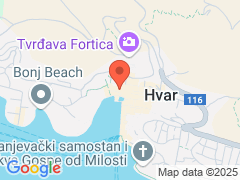
Crkva Gospe Kruvenice / Comments
Looks like you are not signed in!
How would you like to proceed?
Anonymous comment
Login
Register
Your comment was submitted successfully and it will be published after approval by administrator!
General Conditions of Publication
General Conditions of Publiciation
1. Web page
Web page www.holiday-link.com is an interactive web page where the visitors can put texts, news, photos and video movies regarding the content about tourism, gastronomy, culture and entertainment. Information can be uploaded by the owners, managers, employees, tourist boards, residents and tourists, basically all those who want to introduce the public to the specific content (facilities). The site allows evaluation of the attractiveness of a specific content and it allows writing comments by other visitors. Visitors, who log in and want to publish an information about some content (facility) or promote some tourist service, become users or suppliers and they agree to the general terms and conditions that are stipulated here and are obliged to act in accordance with the general terms and conditions (general conditions do not apply if a person is only visiting the page). A person can become a user by signing up with a user name and a password. The user agrees to put the accurate access data, name and surname and the address. Contents that users publish will be signed with a nickname they choose, while the personal data will be used in accordance with the privacy statement. Persons under the age of thirteen are not allowed to enter any content. General terms can be changed from time to time and if the user or supplier doesn’t agree with the changed general terms and conditions he can remove his content from the site.
2. Content
The page is not the media that publishes editorial program contents but the page where the visitors publish information that serve for the educational and cultural public informing about the touristic, cultural and gastronomic contents (facilities). The goal of the site is to collect the information that will give the tourists, as well as the locals, the insight into touristic, cultural and gastronomic offer of the certain location (city, region and country). Publishing the information about the content (information on facilities) is completely free of charge. Except the touristic content , on these pages, providers of various services in tourism may publish and advertise services they offer. These are, further in the text, referred to as a suppliers. Users and suppliers are solely responsible for the publication of their contents in accordance with the statement of responsibility.
3. User obligations
Each user is obliged to use the website in accordance with the general terms and conditions. By publishing the certain text, comment, photo or video movie on the site, the user guarantees that the published information are true, and that they are not copyrighted by a third party. Each user is morally and materially responsible for the publication of content. It is forbidden to copy texts from other websites. Administrators review entered contents and approve them for publishing. Holiday-Link.com has the right not to show the content it finds inappropriate, untrue or offensive. The owners, managers or employees of the gastronomic facilities (eg. restaurants) have the right to reply to the articles and comments on their own content. The owners have the right to request the removal of the text regarding their facilities if they find it inappropriate. The complaint can be send to complain@holiday-link.com. By publishing the content, the user is giving the exclusive, royalty-free, perpetual transferable, irrevocable and fully sublicensable licence (copyright) to use, reproduce modify, adapt, translate, distribute, publish and publicly display subscribed content to the Holiday-Link.com and its affiliates.
4. The obligations of suppliers of tourist services (accommodation and other services)
Company Holiday-Link.com Ltd acts as advertising website on this website and not as a tour operator or intermediary travel agency. Suppliers of tourist services who register their capacity on this site, pay the commercial advertising model they choose. Interaction, regarding arranging a specific accommodation or other tourist service, is done directly between supplier and visitor. Visitors arrange the accommodation or some other touristic service directly with the suppliers and pay the arranged service to them. Suppliers are responsible for all entered data, images, prices and more. Suppliers guarantee that they have all licences necessary to carry out the services they offer, and to operate in accordance with the laws of their home country. By purchasing certain service, visitor accepts the terms and conditions of a supplier from whom he purchased the service. Holiday-Link will check each supplier before putting its facilities to be visible on the page.
5. Statement of Responsibility
The information, that users and suppliers are entering, can be wrong. Holiday-Link.com does not check the entry of the information, pictures and movies and cannot guarantee their accuracy and it disclaims any responsibility for any incorrect data. If you notice a certain misstatement, inaccuracy or inadequacy in any content, please contact us by e-mail: complain@holiday-link.com The responsibility, for every information about some content, is on the user who entered the information. Suppliers, who advertise touristic services via this website, act as independent entrepreneurs. They enter the data about their services , as well as the pictures and the prices, on their own. Holiday-Link.com does not check entered data and disclaims responsibility regarding the errors that can occur during the entering. Suppliers have to own all the licences regarding the services they offer, and they have to respect the laws and regulations of the home country. Visitor arranges the specific service directly with the supplier, on the basis of data that is entered by a supplier as independent entrepreneur, and he pays it directly to the supplier. Therefore, Holiday-Link.com disclaims responsibility for any problem related to the certain reservation.
6. Privacy Policy
When logging into the website, users and suppliers have to enter some personal data (name and surname, e-mail, address, phone number, etc.). Holiday-Link.com guarantees that this data will be kept secret and will not be forwarded to the third parties. Holiday-Link.com can use an user and a supplier e-mail for sending necessarry informaion and for advertising.
7. Cookie Policy
Cookies are small text files that can be stored into device of a visitor if it is allowed by a web browser. Holiday-Link.com uses cookies to provide a better user experience on the website for the visitors. Also, while visiting Holiday-Link.com, you can automatically collect a certain data.
8. Court Jurisdiction
In case of any dispute, related to the site holiday-link.com, the court in Split and the Croatian law are competent.