Chapel of St. Blaise Above Komiža
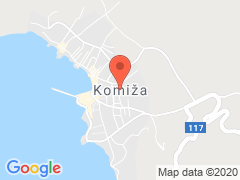
The Chapel of St. Blaise is situated at the pass above the northwestern side of Komiža, high enough to provide a different perspective of the town's houses, harbor, and sea. It is not accessible along the promenade but requires a short hike above the town, along a path that gradually leaves the last houses and enters a rocky landscape dotted with dry stone walls and low Mediterranean vegetation.
The chapel itself is small and simple, lacking an ornate façade and large viewing space. This modest design suits its location well: the stone walls, roof covered with stone slabs, and small bell tower above the entrance appear as a natural extension of the surrounding landscape. It is particularly suitable for those who wish to combine a visit to this old sacred building with a short walk, a view of Komiža, and a stay away from the summer crowds.
How to Reach the Chapel of St. Blaise
From the center of Komiža, first head towards the upper, northwestern part of the town, then continue along a walking path towards the hinterland. The path connects with routes leading to Oključno, Dragodid, and Cape Barjaci. At the junction where one direction leads to Oključno, continue left and uphill towards the pass where the chapel stands.
It takes approximately half an hour to 40 minutes to walk from the waterfront to St. Blaise, depending on the starting point, pace, and heat. The distance is not great, but the entire route gains elevation, making the ascent noticeably more demanding than a regular walk through the town.
The first part passes through the streets and approaches above Komiža, while further along, the path becomes natural and rocky. The route is not technically difficult, but the ground is uneven in places, and small stones can be slippery when descending. Closed sports shoes or sturdy sandals are a much better choice than flip-flops.
At intersections, it is useful to follow the signs for walking routes and have a map saved on your mobile device. The chapel can also be reached as part of a longer circular walk via Dragodid and Barjaci, but for a standalone visit, it is simplest to return the same way to Komiža.
Can You Reach It by Car?
The chapel is located along a walking route and old unpaved roads above Komiža, but it should not be planned as a location that is easily accessible by personal car. There is no designated public parking next to the chapel, and the approaches from the hinterland are not standard roads intended for tourist traffic.
It is best to leave your vehicle at a permitted public parking area in Komiža and complete the ascent on foot. Attempting to reach it by regular car along unpaved roads does not offer significant advantages, and the condition of the ground can change after rain and the passage of heavier vehicles.
View of Komiža
One of the main reasons for the ascent is the view that opens up from the pass and the approach path. Below, you can see Komiža and its bay, the rooftops of old houses, the harbor, and the sea towards the western side of Vis. As you climb above the town, the urban noise quickly fades, and the entire area becomes more open and tranquil.
The chapel is not a developed viewpoint with railings, benches, and tourist infrastructure. The view extends from the natural terrain around the chapel, so care should be taken where you step, especially near the edges of the rocky terrain and during descent.
The most pleasant times to visit are early in the morning or late in the afternoon. The morning ascent is easier due to lower temperatures, while the evening light above Komiža is softer, making the view towards the sea particularly striking. However, the return should begin early enough as the path is not illuminated.
A Small Church with a Long History
The history of St. Blaise is not fully clarified. One official source connects it with the Benedictines from Biševo, stating that it was mentioned as early as the 12th century and was renovated in the 14th and 16th centuries. The tourist board of Komiža notes that the exact year of construction is unknown, but older records suggest that the current chapel has existed since at least the 16th century.
For visitors, what is clearly visible on-site is more important: a modest stone building, a roof of stone slabs, and a small bell tower that is still functional. The interior is not regularly open, so visits generally consist of viewing from the outside and a brief stay near the chapel.
St. Blaise is traditionally venerated as the protector of the throat. According to local tradition, mass is held in this remote chapel on his feast day, during which the blessing of throats is performed. For the rest of the year, the doors are mostly closed, so entry should not be expected.
Who is This Trip Most Suitable For?
The walk to St. Blaise is a good choice for adults and older children accustomed to walking on rocky paths. It is not a long hiking tour, but the ascent, sun, and uneven ground require at least basic fitness.
For small children, strollers, elderly individuals who have difficulty walking, and those with limited mobility, this location is not practical. There are no accessible paths, handrails, or flat paved surfaces near the chapel.
There are no tourist facilities at the site. It is advisable to bring water, sun protection, and everything needed for walking, especially in summer. There are no places to buy drinks or food along the path or near the chapel, and there is not enough natural shade to rely on throughout the entire route.
Best Time to Visit
The chapel can be visited year-round, but spring and autumn are the most pleasant due to milder temperatures and greener landscapes. In winter, it is advisable to avoid days with strong winds and rain, as the rocky ground can become slippery.
In summer, it is not recommended to set out around noon. The path is largely exposed to the sun, and the return to Komiža involves descending on heated stones. It is best to start early in the morning or a few hours before sunset, allowing enough time for a calm return before dark.
The Chapel of St. Blaise is not a large landmark visited for its rich interior. It is worth visiting for the walk above Komiža, the simple old architecture, and the feeling of transitioning from a lively coastal town to a completely different, quieter part of the island of Vis.


Kapelica sv. Blaža / Comments
Looks like you are not signed in!
How would you like to proceed?
Anonymous comment
Login
Register
Your comment was submitted successfully and it will be published after approval by administrator!
General Conditions of Publication
General Conditions of Publiciation
1. Web page
Web page www.holiday-link.com is an interactive web page where the visitors can put texts, news, photos and video movies regarding the content about tourism, gastronomy, culture and entertainment. Information can be uploaded by the owners, managers, employees, tourist boards, residents and tourists, basically all those who want to introduce the public to the specific content (facilities). The site allows evaluation of the attractiveness of a specific content and it allows writing comments by other visitors. Visitors, who log in and want to publish an information about some content (facility) or promote some tourist service, become users or suppliers and they agree to the general terms and conditions that are stipulated here and are obliged to act in accordance with the general terms and conditions (general conditions do not apply if a person is only visiting the page). A person can become a user by signing up with a user name and a password. The user agrees to put the accurate access data, name and surname and the address. Contents that users publish will be signed with a nickname they choose, while the personal data will be used in accordance with the privacy statement. Persons under the age of thirteen are not allowed to enter any content. General terms can be changed from time to time and if the user or supplier doesn’t agree with the changed general terms and conditions he can remove his content from the site.
2. Content
The page is not the media that publishes editorial program contents but the page where the visitors publish information that serve for the educational and cultural public informing about the touristic, cultural and gastronomic contents (facilities). The goal of the site is to collect the information that will give the tourists, as well as the locals, the insight into touristic, cultural and gastronomic offer of the certain location (city, region and country). Publishing the information about the content (information on facilities) is completely free of charge. Except the touristic content , on these pages, providers of various services in tourism may publish and advertise services they offer. These are, further in the text, referred to as a suppliers. Users and suppliers are solely responsible for the publication of their contents in accordance with the statement of responsibility.
3. User obligations
Each user is obliged to use the website in accordance with the general terms and conditions. By publishing the certain text, comment, photo or video movie on the site, the user guarantees that the published information are true, and that they are not copyrighted by a third party. Each user is morally and materially responsible for the publication of content. It is forbidden to copy texts from other websites. Administrators review entered contents and approve them for publishing. Holiday-Link.com has the right not to show the content it finds inappropriate, untrue or offensive. The owners, managers or employees of the gastronomic facilities (eg. restaurants) have the right to reply to the articles and comments on their own content. The owners have the right to request the removal of the text regarding their facilities if they find it inappropriate. The complaint can be send to complain@holiday-link.com. By publishing the content, the user is giving the exclusive, royalty-free, perpetual transferable, irrevocable and fully sublicensable licence (copyright) to use, reproduce modify, adapt, translate, distribute, publish and publicly display subscribed content to the Holiday-Link.com and its affiliates.
4. The obligations of suppliers of tourist services (accommodation and other services)
Company Holiday-Link.com Ltd acts as advertising website on this website and not as a tour operator or intermediary travel agency. Suppliers of tourist services who register their capacity on this site, pay the commercial advertising model they choose. Interaction, regarding arranging a specific accommodation or other tourist service, is done directly between supplier and visitor. Visitors arrange the accommodation or some other touristic service directly with the suppliers and pay the arranged service to them. Suppliers are responsible for all entered data, images, prices and more. Suppliers guarantee that they have all licences necessary to carry out the services they offer, and to operate in accordance with the laws of their home country. By purchasing certain service, visitor accepts the terms and conditions of a supplier from whom he purchased the service. Holiday-Link will check each supplier before putting its facilities to be visible on the page.
5. Statement of Responsibility
The information, that users and suppliers are entering, can be wrong. Holiday-Link.com does not check the entry of the information, pictures and movies and cannot guarantee their accuracy and it disclaims any responsibility for any incorrect data. If you notice a certain misstatement, inaccuracy or inadequacy in any content, please contact us by e-mail: complain@holiday-link.com The responsibility, for every information about some content, is on the user who entered the information. Suppliers, who advertise touristic services via this website, act as independent entrepreneurs. They enter the data about their services , as well as the pictures and the prices, on their own. Holiday-Link.com does not check entered data and disclaims responsibility regarding the errors that can occur during the entering. Suppliers have to own all the licences regarding the services they offer, and they have to respect the laws and regulations of the home country. Visitor arranges the specific service directly with the supplier, on the basis of data that is entered by a supplier as independent entrepreneur, and he pays it directly to the supplier. Therefore, Holiday-Link.com disclaims responsibility for any problem related to the certain reservation.
6. Privacy Policy
When logging into the website, users and suppliers have to enter some personal data (name and surname, e-mail, address, phone number, etc.). Holiday-Link.com guarantees that this data will be kept secret and will not be forwarded to the third parties. Holiday-Link.com can use an user and a supplier e-mail for sending necessarry informaion and for advertising.
7. Cookie Policy
Cookies are small text files that can be stored into device of a visitor if it is allowed by a web browser. Holiday-Link.com uses cookies to provide a better user experience on the website for the visitors. Also, while visiting Holiday-Link.com, you can automatically collect a certain data.
8. Court Jurisdiction
In case of any dispute, related to the site holiday-link.com, the court in Split and the Croatian law are competent.