Ines Vlašić Gallery – A Family Artistic Space in the Heart of Šibenik
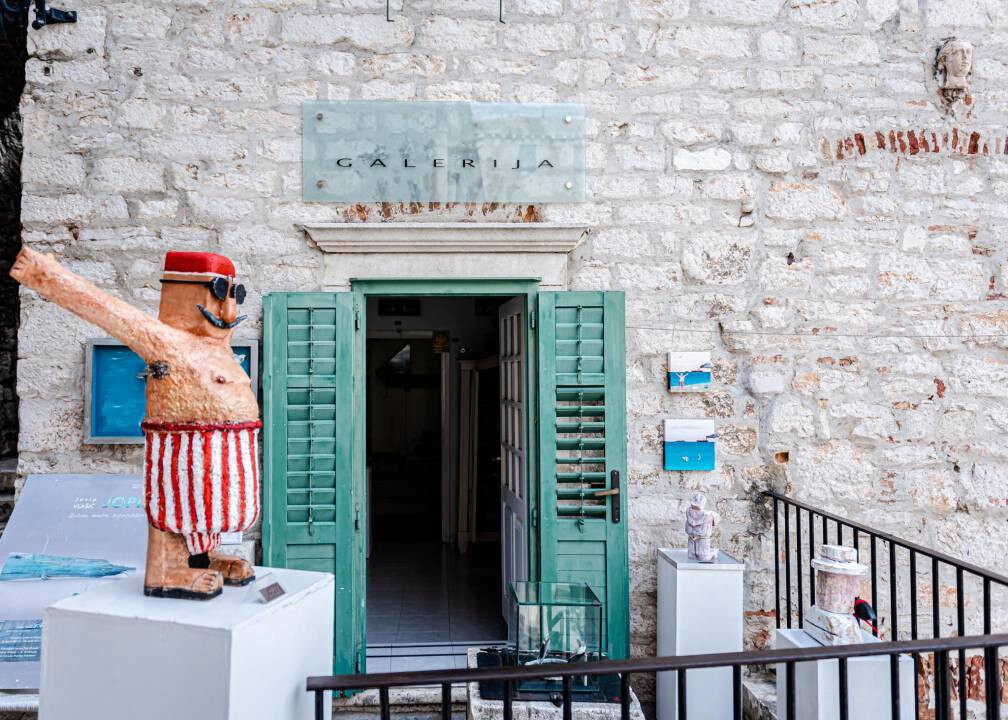
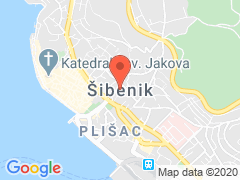
Just above the Cathedral of St. James, where the illuminated stone streets of Šibenik ascend from the waterfront to the old town, a small gallery hides behind an attractive collection of unusual art objects and jewelry. It does not announce itself with the seriousness of a museum or the polished distance of a traditional exhibition space. The Ines Vlašić Gallery feels personal, as if you have stepped into the home of a particularly imaginative family and discovered that each item has a name, a memory, and a story waiting to be told.
Located at Trg Republike Hrvatske 6, the gallery has become a recognizable part of the Šibenik art scene. Local media describe it as a small and harmonious space run by the Vlašić artistic family for over twenty years, whose connection to Šibenik began with their first encounter with the city. The paintings, jewelry, and sculptures are not linked by a single technique but by a shared sensibility: tenderness, humor, craftsmanship, and a deep emotional connection to the Adriatic.
Jewelry that Holds a Secret
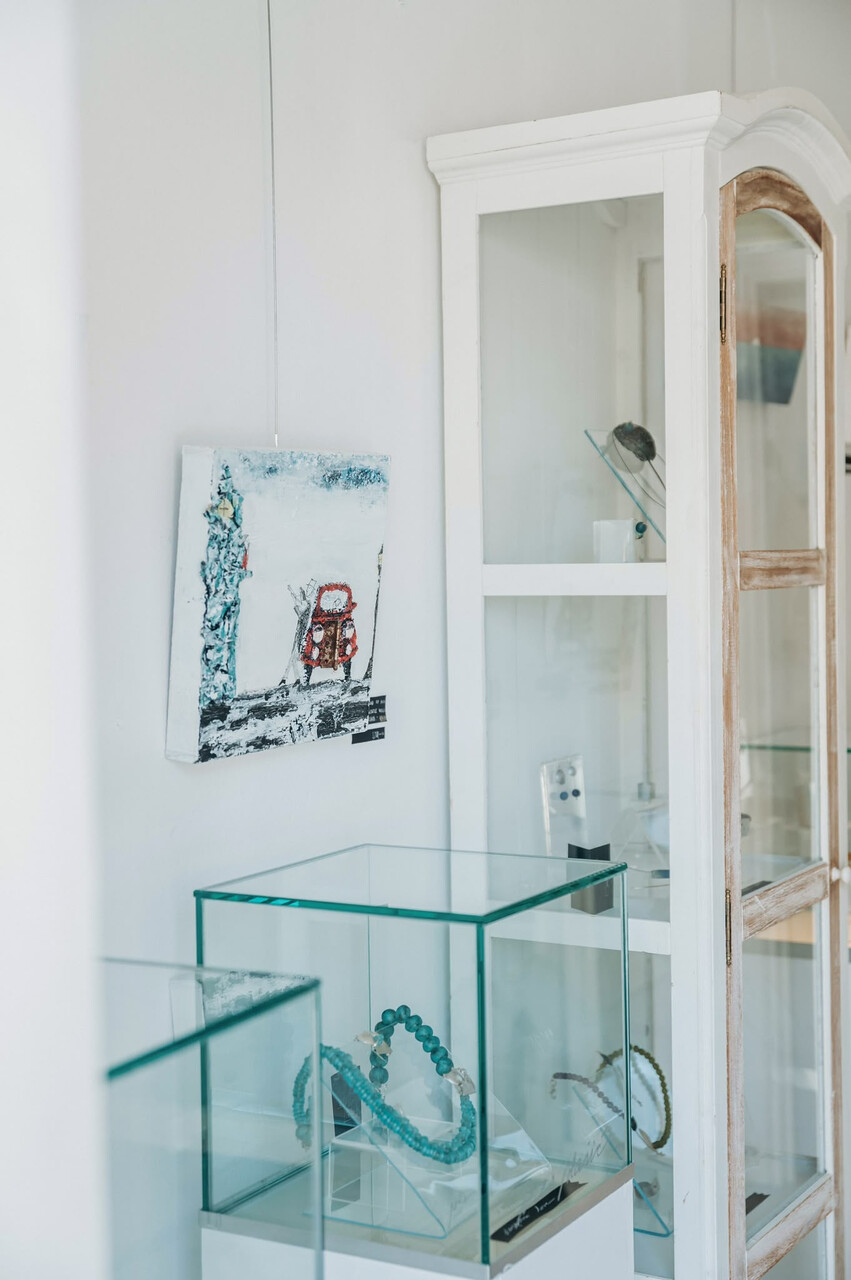
At the center of the gallery is the work of Ines Vlašić, an artist and jewelry designer whose creations blur the line between ornament and miniature sculpture.
Ines was born in Varaždin in 1971 and has been developing her unique approach to artistic jewelry for about fifteen years. In 2010, the City Museum of Varaždin presented her solo exhibition titled "Come, Hug Me, for the Picture." The museum described her earrings, bracelets, and brooches as miniature sculptures and illustrations shaped in silver, often enriched with colored elements and replicas of ancient glass. Her work is also associated with institutions such as the Museum of Arts and Crafts in Zagreb and the Museum of Ancient Glass in Zadar.
However, the materials alone do not explain the appeal of Ines's work. Her jewelry begins with emotion: a remembered conversation, a private joke, a legend, a moment of tenderness, or a fragment of the past. Her earlier works bore distinctly intimate titles such as "Kiss Me," "Let Me Sleep," and "Miss Luna." Because of these names, each piece feels less like an accessory and more like a small character with its own personality.
Her designs draw on cultural and historical forms but do not turn them into copies of the past. Silver, bronze, and glass are shaped with a recognizable personal artistic language, sometimes elegant, sometimes playful, and sometimes almost talismanic. Contemporary in execution but rooted in ancient customs of personal adornment, this jewelry seems to understand that people do not wear beautiful objects merely for decoration. We wear them to remember, to communicate, and to carry a small part of ourselves into the world.
For this reason, these pieces hold special meaning when discovered during travel. They are not generic souvenirs from Croatia. They contain something much subtler: the feeling of a warm stone street in the late afternoon, the reflection of light on the sea, and the intimacy of finding an object that seems to have been made just for a particular person.
Josip Vlašić and the Second Life of the Sea
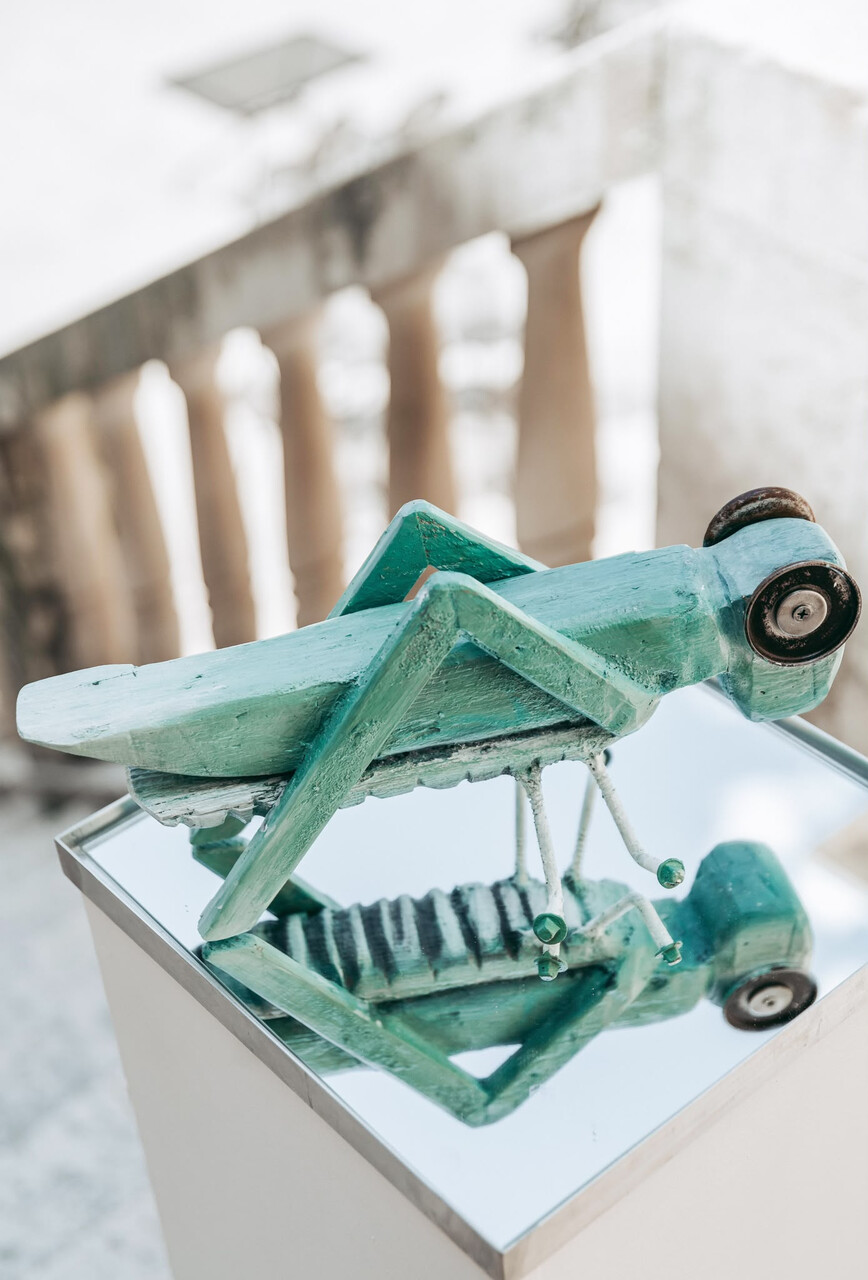
Alongside the refinement of Ines's jewelry stands the work of Josip Vlašić, whose sculptures often emerge from materials that have already lived one life.
Josip works with pieces of driftwood that he collects throughout the year from hidden corners of the Adriatic coast and beyond. Shaped by salt, water, and time, these fragments already possess their own irregular forms, scars, and textures. Rather than completely imposing his vision on the wood, Josip seems to seek the shape that is already hidden within it. His task is not to erase the material's past but to continue it.
Ines and Josip have jointly presented their works across Europe, from the Ericsson Nikola Tesla Gallery in Zagreb to the Naivistit exhibition in Iittala, Finland. The combination of jewelry and sculpture emphasizes the contrast of their chosen materials, as well as something fundamental in their shared artistic world: strength and vulnerability, humor and sensitivity, permanence and change.
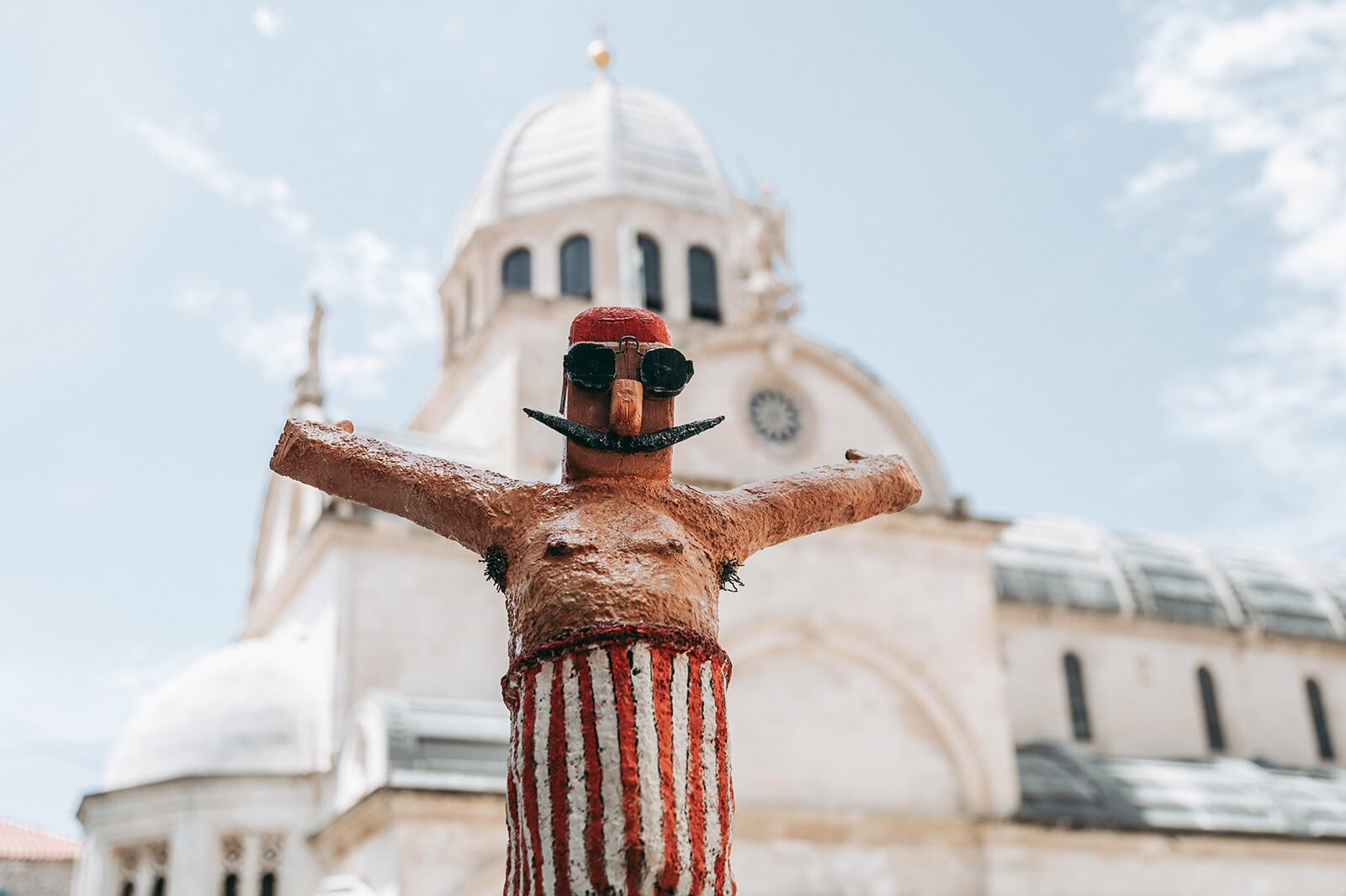
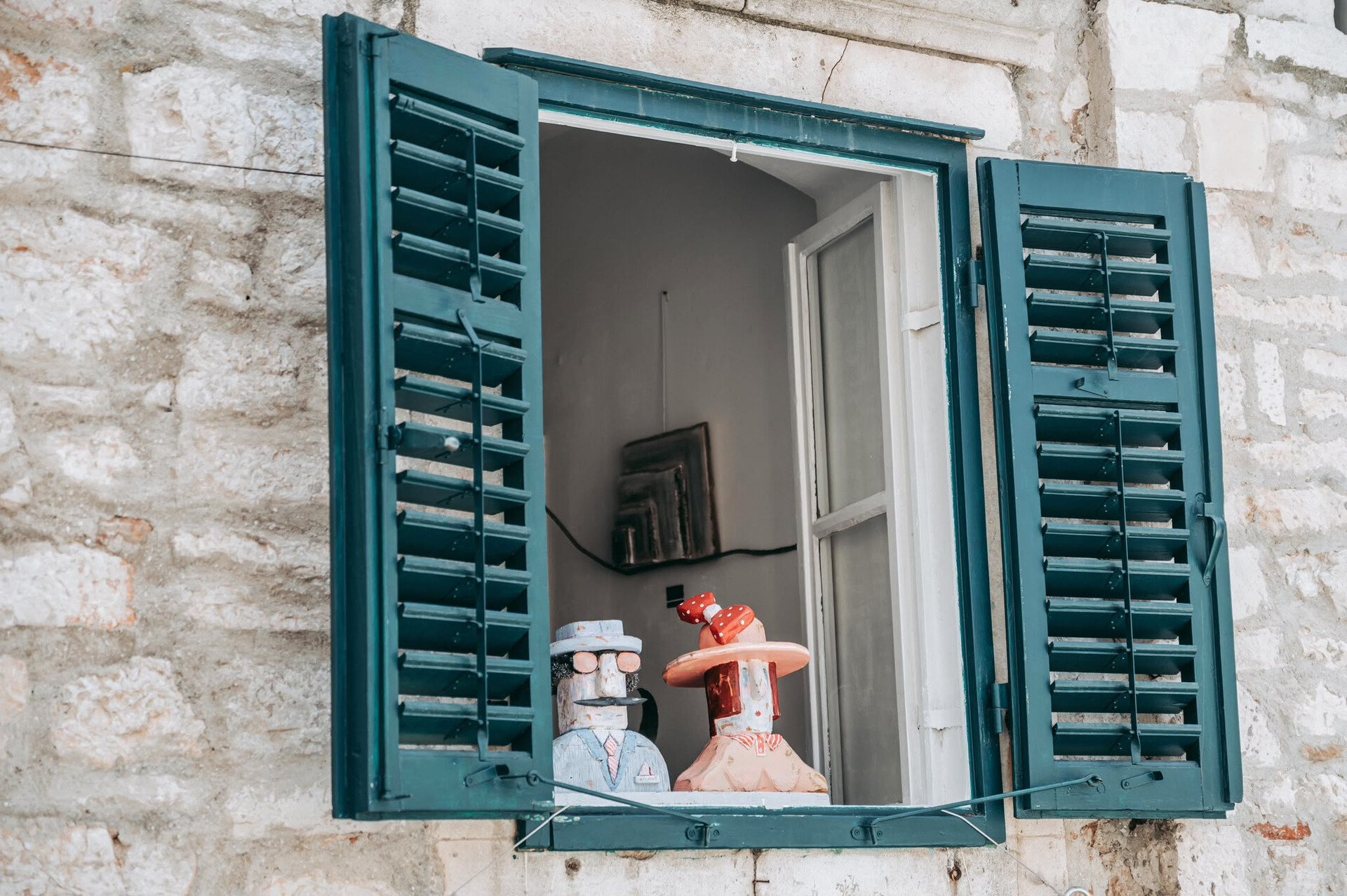
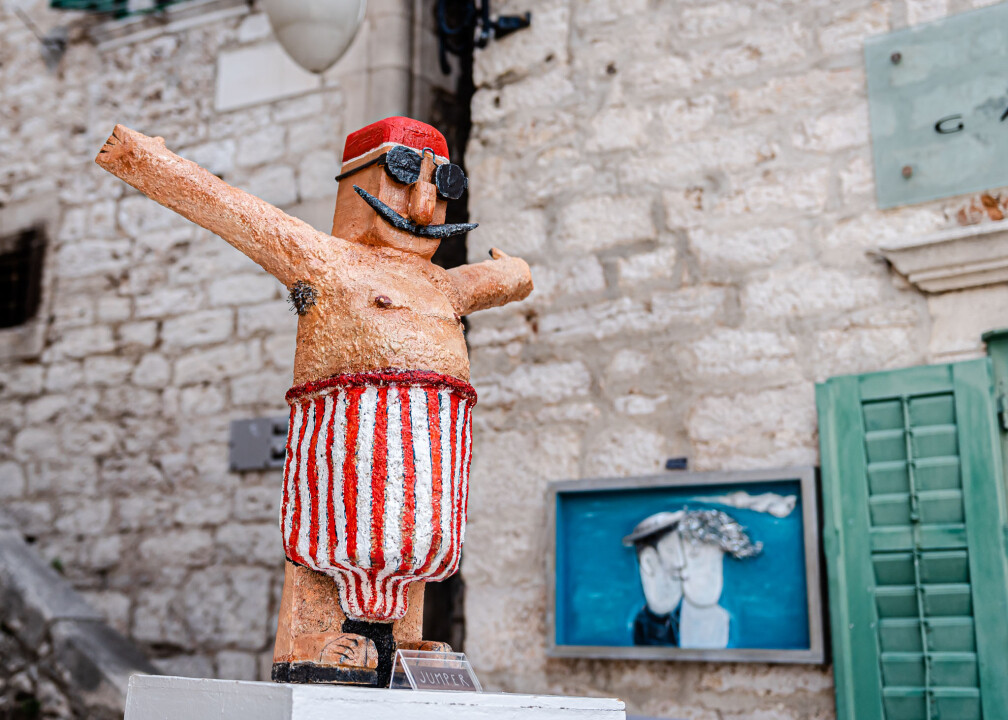
Josip's sea-shaped figures bring a mischievous spirit into the gallery. They are not burdened by their own importance. Their humor is insightful, restrained, and warm, finding comedy in posture, character, and everyday life. Visitors often highlight the humor in the paintings and sculptures, but this laughter is never malicious. These are characters created with affection, recognizable to people around the world.
In Josip's hands, something abandoned on the shore becomes visible again. A curved branch may remind one of a nose, a sailor's posture, or the silhouette of an eccentric neighbor. A piece of wood that was first shaped by a tree, then by the sea, is ultimately shaped by imagination. Its irregularities are not hidden; rather, they give the sculpture its personality.
Nikola Vlašić: Love, Observation, and the Adriatic
The paintings and sculptures of Nikola Vlašić introduce another voice into the gallery – contemporary, graphic, and often cinematic, yet strongly connected to the same culture of observation and storytelling.
Nikola describes his approach as "creating through observation." He speaks of respect for trees and recognizing the history preserved in discarded materials: memories of a garden, a park, childhood, or a home where birds once lived, as taught by his parents. Recycled parts and abandoned objects in his work are not just practical materials. They are carriers of memories waiting for someone to notice and revive them.
His artistic world is populated by loving couples, fishermen, swimmers, sailors, animals, musicians, and incredible local heroes. Works with titles such as "Pablo," "Ankica," "Jiminy," "God," "Let It Be 2:1 for Us," "I Will Follow You Forever," and "She and I on the Edge of the Sea" reveal an artist who is interested not only in form and appearance but also in character and story. The titles often act like the first sentence of a narrative, leaving the observer to imagine everything that happened before and everything that could happen after.
The Adriatic in Nikola's works is not an empty postcard scene. It is inhabited. It is filled with longing, romance, sport, fishing, stubbornness, music, and the quiet absurdities of everyday life. His characters may be simplified and playful, but their emotional core remains sincere. A sailor is never just a sailor; perhaps he is waiting for someone. A boat may carry the memory of a song. A couple in love may embody an entire Dalmatian philosophy of loyalty, pride, and gentle theatricality.
Nikola's works have been exhibited in Croatia, Slovenia, the Netherlands, and Germany. In all these contexts, his main theme has remained remarkably consistent: the relationship between personal memory and the sea.
Three Artistic Voices, One Family Language
The beauty of the Ines Vlašić Gallery lies in how these three artistic approaches complement each other without becoming interchangeable.
Ines works on an intimate scale, transforming silver and glass into wearable memories. Josip listens to wood that has been shaped by the sea and discovers figures in its worn forms. Nikola combines painting, sculpture, design, and recycled materials to shape a contemporary mythology of Adriatic life.
Each artist has their own voice, but all three share the belief that objects can carry stories, souls, and emotions. They notice what others might overlook: a piece of wood, an old symbol, a comic gesture, a casually spoken sentence, or a moment between two people. In their hands, it usually does not turn into something pretentious. It becomes precious.
For this reason, the gallery avoids the usual division between "serious" art and objects intended for everyday life. A brooch can be a sculpture. A piece of driftwood can become a portrait. A humorously painted character can carry genuine tenderness. Beauty can be intelligent without becoming cold, while art can evoke a smile without losing depth.
More than a Gallery Visit
Visitors often describe the Ines Vlašić Gallery as a hidden gem, but what they remember most is not just the art. Reviews repeatedly mention the kindness and hospitality, conversations with Ines or Josip, and the feeling of a personal encounter rather than an anonymous purchase. One visitor simply described the experience as "a human encounter," while another recalls a gift, a conversation, or finding an item that became the perfect memento of their time in Croatia.
This human warmth is key to the identity of the gallery. It offers something increasingly rare in historic urban cores: a place where art is not separated from the people who created it. Questions are welcome. Stories are exchanged. Visitors are not rushed through a carefully orchestrated sales experience; instead, they are invited to look, smile, and discover.
Perhaps this is the gallery's greatest achievement. It showcases the Adriatic but does not reduce it to blue seas, stone houses, and well-known symbols. Instead, it reveals the coast as it is truly lived: full of unusual characters, personal histories, old materials, enduring love, and humor strong enough to survive both summer heat and winter storms.
The Ines Vlašić Gallery can easily be overlooked if you pass by too quickly. But once you enter, a whole world opens up – a world composed of silver and glass, wood and color, memories and observations. It is a family portrait of the Adriatic, without posing and without polishing to perfection, yet warm, imaginative, and beautifully alive.


Inside the world of Ines Vlašić Gallery in Šibenik / Comments
Looks like you are not signed in!
How would you like to proceed?
Anonymous comment
Login
Register
Your comment was submitted successfully and it will be published after approval by administrator!
General Conditions of Publication
General Conditions of Publiciation
1. Web page
Web page www.holiday-link.com is an interactive web page where the visitors can put texts, news, photos and video movies regarding the content about tourism, gastronomy, culture and entertainment. Information can be uploaded by the owners, managers, employees, tourist boards, residents and tourists, basically all those who want to introduce the public to the specific content (facilities). The site allows evaluation of the attractiveness of a specific content and it allows writing comments by other visitors. Visitors, who log in and want to publish an information about some content (facility) or promote some tourist service, become users or suppliers and they agree to the general terms and conditions that are stipulated here and are obliged to act in accordance with the general terms and conditions (general conditions do not apply if a person is only visiting the page). A person can become a user by signing up with a user name and a password. The user agrees to put the accurate access data, name and surname and the address. Contents that users publish will be signed with a nickname they choose, while the personal data will be used in accordance with the privacy statement. Persons under the age of thirteen are not allowed to enter any content. General terms can be changed from time to time and if the user or supplier doesn’t agree with the changed general terms and conditions he can remove his content from the site.
2. Content
The page is not the media that publishes editorial program contents but the page where the visitors publish information that serve for the educational and cultural public informing about the touristic, cultural and gastronomic contents (facilities). The goal of the site is to collect the information that will give the tourists, as well as the locals, the insight into touristic, cultural and gastronomic offer of the certain location (city, region and country). Publishing the information about the content (information on facilities) is completely free of charge. Except the touristic content , on these pages, providers of various services in tourism may publish and advertise services they offer. These are, further in the text, referred to as a suppliers. Users and suppliers are solely responsible for the publication of their contents in accordance with the statement of responsibility.
3. User obligations
Each user is obliged to use the website in accordance with the general terms and conditions. By publishing the certain text, comment, photo or video movie on the site, the user guarantees that the published information are true, and that they are not copyrighted by a third party. Each user is morally and materially responsible for the publication of content. It is forbidden to copy texts from other websites. Administrators review entered contents and approve them for publishing. Holiday-Link.com has the right not to show the content it finds inappropriate, untrue or offensive. The owners, managers or employees of the gastronomic facilities (eg. restaurants) have the right to reply to the articles and comments on their own content. The owners have the right to request the removal of the text regarding their facilities if they find it inappropriate. The complaint can be send to complain@holiday-link.com. By publishing the content, the user is giving the exclusive, royalty-free, perpetual transferable, irrevocable and fully sublicensable licence (copyright) to use, reproduce modify, adapt, translate, distribute, publish and publicly display subscribed content to the Holiday-Link.com and its affiliates.
4. The obligations of suppliers of tourist services (accommodation and other services)
Company Holiday-Link.com Ltd acts as advertising website on this website and not as a tour operator or intermediary travel agency. Suppliers of tourist services who register their capacity on this site, pay the commercial advertising model they choose. Interaction, regarding arranging a specific accommodation or other tourist service, is done directly between supplier and visitor. Visitors arrange the accommodation or some other touristic service directly with the suppliers and pay the arranged service to them. Suppliers are responsible for all entered data, images, prices and more. Suppliers guarantee that they have all licences necessary to carry out the services they offer, and to operate in accordance with the laws of their home country. By purchasing certain service, visitor accepts the terms and conditions of a supplier from whom he purchased the service. Holiday-Link will check each supplier before putting its facilities to be visible on the page.
5. Statement of Responsibility
The information, that users and suppliers are entering, can be wrong. Holiday-Link.com does not check the entry of the information, pictures and movies and cannot guarantee their accuracy and it disclaims any responsibility for any incorrect data. If you notice a certain misstatement, inaccuracy or inadequacy in any content, please contact us by e-mail: complain@holiday-link.com The responsibility, for every information about some content, is on the user who entered the information. Suppliers, who advertise touristic services via this website, act as independent entrepreneurs. They enter the data about their services , as well as the pictures and the prices, on their own. Holiday-Link.com does not check entered data and disclaims responsibility regarding the errors that can occur during the entering. Suppliers have to own all the licences regarding the services they offer, and they have to respect the laws and regulations of the home country. Visitor arranges the specific service directly with the supplier, on the basis of data that is entered by a supplier as independent entrepreneur, and he pays it directly to the supplier. Therefore, Holiday-Link.com disclaims responsibility for any problem related to the certain reservation.
6. Privacy Policy
When logging into the website, users and suppliers have to enter some personal data (name and surname, e-mail, address, phone number, etc.). Holiday-Link.com guarantees that this data will be kept secret and will not be forwarded to the third parties. Holiday-Link.com can use an user and a supplier e-mail for sending necessarry informaion and for advertising.
7. Cookie Policy
Cookies are small text files that can be stored into device of a visitor if it is allowed by a web browser. Holiday-Link.com uses cookies to provide a better user experience on the website for the visitors. Also, while visiting Holiday-Link.com, you can automatically collect a certain data.
8. Court Jurisdiction
In case of any dispute, related to the site holiday-link.com, the court in Split and the Croatian law are competent.