St Stephen's Cathedral in Hvar – history, Renaissance bell tower, valuable artworks and a symbol of the town
St Stephen's Cathedral is the most significant sacred building in Hvar and one of its most recognisable historical monuments. Located at the eastern end of St Stephen's Square, known as Pjaca, it has dominated the main town square for centuries with its monumental façade and slender Renaissance bell tower. Dedicated to St Stephen I, Pope and Martyr, the patron saint of Hvar and the Hvar Diocese, the cathedral has evolved over centuries from a medieval church to a representative building that intertwines Gothic, Renaissance, and Baroque elements. Inside, it houses valuable altars, artworks by Venetian painters, and a historic crucifix linked to one of the most important events in Hvar's history. Today, the cathedral remains the centre of religious life in the town and an unmissable landmark for visitors wishing to explore the cultural and artistic heritage of Hvar Island.
St Stephen's Cathedral – the most famous church in Hvar
St Stephen's Cathedral is situated on the eastern side of the main town square, where its stone façade and tall bell tower create one of Hvar's most iconic views.
Pjaca stretches westward from the cathedral, reaching the area of the former Mandrač and the current town harbour. It is the largest town square in Dalmatia, a space that has been the centre of public and social life for centuries.
Due to its location, the cathedral plays a crucial role in the urban design of the town. Unlike many Dalmatian churches situated in narrow streets, its façade can be admired from a considerable distance across the open square.
The bright stone, harmoniously shaped façade, and Renaissance bell tower rising to its left stand out particularly well.
The cathedral is not just a tourist attraction; it is the seat of the Bishop of Hvar, a place for regular services and important church ceremonies, thus retaining its role throughout much of the town's history.
The History of the Cathedral – from Benedictine Monastery to Episcopal Seat
The history of Hvar Cathedral began long before the construction of its present façade.
On this site once stood the Benedictine monastery of St Mary of Lesna, alongside which there was an older church. This building gradually gained increasing importance in the religious life of the town during the Middle Ages.
In the 13th century, when the seat of the Hvar Diocese was moved from Stari Grad to Hvar, the existing church became a cathedral.
This change also altered its significance. It was no longer merely a monastic or town church but the central sacred space of the diocese encompassing the islands of Hvar, Brač, and Vis.
During the 14th and 15th centuries, the building was expanded and adapted to new needs.
Later, extensive works began to create a representative cathedral that would reflect Hvar's importance as a maritime, trading, and administrative centre.
The current structure is the result of a long period of construction and renovation, rather than a single architectural intervention.
Construction of the Current Cathedral from the 16th to 18th Century
The most significant phase in shaping the current cathedral took place between the 16th and 18th centuries.
During this period, the façade, sanctuary, and interior were gradually remodelled, connecting older Gothic parts with Renaissance and Baroque elements.
Local and Korčula stone masons, along with other craftsmen active along the Dalmatian coast, participated in the construction.
Among the builders associated with the cathedral's works are Ivan Pomenić and Nikola Vlahotić, while Korčula masters from the Karlić family worked on the bell tower.
Construction progressed gradually, with occasional interruptions due to financial and organisational difficulties.
The cathedral was consecrated in 1706, although the final works were not yet completed at that time.
The façade was finally finished in the mid-18th century, giving the building the appearance we largely recognise today.
This long development is why various artistic styles can be seen in the cathedral, as well as traces of earlier construction phases.
Renaissance Façade – a Symbol of the Holy Trinity
One of the most important architectural features of Hvar Cathedral is its monumental façade.
Designed in a late Renaissance style, it features pronounced stone frames, pilasters, and decorative elements.
At the top, there is a distinctive trefoil finial symbolising the Holy Trinity.
This shape gives the façade a unique appearance, setting it apart from many other Dalmatian churches.
The main entrance, with its stone portal, is located in the central part. In its lunette, there is a depiction of St Stephen the Pope, to whom the cathedral is dedicated.
On either side of the façade are tall windows that further emphasise its verticality.
While the basic character of the façade is Renaissance, some decorative details show a transition to later artistic styles.
It is particularly interesting how the façade is adapted to the width of the cathedral's nave, while the side aisles are partially recessed.
This solution achieves a harmonious monumental whole that dominates the entire square.
The Bell Tower of Hvar Cathedral – a Masterpiece of Dalmatian Renaissance
The Renaissance bell tower is one of Hvar's most recognisable symbols.
It is located on the northern side of the façade, and its construction began in the first half of the 16th century.
It was completed in 1549, or around 1549 and 1550 according to various historical accounts.
Korčula stone masons Marko and Nikola Karlić worked on its construction.
The bell tower rises through several architecturally distinct levels.
Of particular interest is the arrangement of window openings, which become increasingly numerous towards the top. From simpler openings in the lower part, it transitions to multi-part arcades on the upper floors.
This gradual openness gives the bell tower a sense of lightness, despite its stone construction.
At the base, there is a Renaissance portal that provides access to the north aisle of the cathedral.
The bell tower is particularly impressive when viewed from the main square, as well as from the Fortica fortress, where it stands out among the roofs of the historic core.
Due to its proportions and the quality of its stonework details, it is considered one of the valuable examples of Renaissance architectural heritage on the Dalmatian islands.
The Interior of the Cathedral – a Blend of Gothic, Renaissance, and Baroque
The interior of the cathedral features a three-nave basilica layout.
The central nave is separated from the side aisles by stone columns and arches, and the space continues towards the east into the sanctuary and choir.
Architectural elements from different periods have been preserved in the design.
Gothic details are particularly visible in parts of the older church furnishings, while the Renaissance is present in the design of the choir and certain architectural elements.
Baroque strongly influenced the altars, decoration, and later renovations of the space.
This stylistic intertwining is not the result of a later attempt to connect different artistic directions but a natural reflection of the building's centuries-old history.
Visitors can notice how simpler stone parts of the church alternate with richly decorated altars.
Particular attention should be paid to the paintings, pulpits, chapels, and stone tombstones preserved in the floor.
Nine Baroque Altars and Valuable Artworks
One of the greatest artistic values of the cathedral is its collection of altars.
Inside, there are nine Baroque altars from the 17th century, adorned with paintings and sculptural elements.
Their architecture connects stone columns, decorative friezes, and altar paintings created by artists associated with the Venetian painting tradition.
Notably, the works of Palma il Giovane, one of the renowned Venetian painters of the late Renaissance and early Baroque, stand out.
His painting on the main altar occupies a prominent place in the artistic heritage of the cathedral.
The value of the altars lies not only in their individual artistic quality but also in the fact that together they depict the richness of Hvar's sacred life during the period of Venetian rule.
For art lovers, the cathedral offers an intriguing insight into how Dalmatian churches adopted artistic influences from Venice while simultaneously preserving their own local architectural tradition.
The Chapel of the Holy Cross and the Historic Crucifix from 1510
One of the most historically interesting parts of the cathedral is located in the Chapel of the Holy Cross.
It houses a small Gothic crucifix linked to events preceding the great popular uprising in Hvar.
According to local tradition, the crucifix bled on 6 February 1510, the feast of St Dorothea.
This event was interpreted in tradition as a call to the inhabitants for penance and reconciliation during a period of pronounced social tensions between the common people and the nobility.
Shortly thereafter, an uprising led by Matija Ivanić began, marking one of the most significant events in the island's history.
The historical importance of the crucifix stems from its connection to the religious and social life of Hvar at the beginning of the 16th century.
Today, it is an important part of the cathedral's sacred heritage and a testament to the strong connection between religious tradition and local history.
The Chapel of St Prosper – Co-Patron Saint of Hvar
The cathedral also features the Chapel of St Prosper, co-patron saint of Hvar.
It is particularly significant due to the relics of the saint that were brought to Hvar from Rome during the 17th century.
Their arrival is associated with the Bishop of Hvar, Ivan Andreis.
The veneration of St Prosper has become an important part of local religious tradition.
The chapel is integrated into the architectural whole of the cathedral and is one of the spaces that showcase its gradual expansion and Baroque renovation.
For visitors interested in local history, it is particularly interesting that Hvar, alongside its main patron St Stephen I, also venerates St Prosper.
St Stephen I – Patron Saint of Hvar and the Hvar Diocese
Hvar Cathedral is dedicated to St Stephen I, Pope and Martyr from the 3rd century.
It is important to distinguish him from St Stephen the Protomartyr, who was one of the first Christian martyrs.
St Stephen I was the Bishop of Rome, or Pope, from 254 to 257 AD.
In Hvar's tradition, he is venerated as the patron saint of the town and diocese.
His feast day in Hvar is celebrated on 2 October, which also marks the Day of the Town of Hvar.
On this day, the cathedral plays a special role in the celebrations, which include a mass and traditional procession.
The feast is one of the more important annual events for the local community, as it connects church tradition, the historical identity of the town, and contemporary public life.
The Bishop's Palace and the Hvar Cathedral Treasury
Adjacent to the cathedral is the Bishop's Palace, an important part of the historical sacred complex of Hvar.
Within its premises is the cathedral treasury, a collection of valuable church and artistic items.
The collection includes liturgical vessels, vestments, reliquaries, items made of precious metals, and other valuables related to the history of the Hvar Diocese.
Among the notable items are examples of old liturgical vestments with rich embroidery, episcopal items, and works from top goldsmith workshops.
Particularly interesting are items from the 15th and 16th centuries that testify to Hvar's artistic connections with other Dalmatian towns and Venice.
Also important within the cathedral complex is the capitular library, whose origins date back to the 15th century.
For art and history enthusiasts, the treasury represents a valuable addition to a visit to the cathedral.
It is important to distinguish between visiting the church itself and the treasury, as these are separate spaces that may have different access conditions.
The Cathedral and the Development of St Stephen's Square
The location of the cathedral is closely linked to the development of today's St Stephen's Square.
During the Middle Ages, the square gradually took shape as the town's centre, and by the 15th century, its basic layout was already recognisable.
On the eastern side stands the cathedral, while the western part of the square opens towards the town harbour.
This arrangement connects the sacred centre of the town with its maritime and trading life.
Surrounding the square, noble palaces, public buildings, and spaces for everyday town activities gradually emerged.
Today, Pjaca retains a similar role as it did in past centuries: it is a place for meetings, strolls, celebrations, and public events.
The cathedral is a permanent architectural and symbolic point in this space, present in almost every well-known panoramic photograph of Hvar's centre.
What to Look Out for During Your Visit
When visiting the cathedral, it is worth taking the time to notice a few details that can easily be overlooked during a quick tour.
First, from the main square, you can admire the entirety of the façade and bell tower. From a greater distance, the trefoil finial of the façade and the relationship between the various architectural elements are best observed.
As you approach the entrance, the stone portal and the depiction of St Stephen the Pope draw attention.
Inside, the Baroque altars and paintings by Venetian masters are particularly interesting.
Be sure to check out the Chapel of the Holy Cross with its historic crucifix and the Chapel of St Prosper, both of which hold a special place in local religious tradition.
On the floor, you can also spot some preserved tombstones that remind visitors of the former burial customs within churches.
A leisurely visit is best planned for approximately 20 to 30 minutes, while those with a keen interest in sacred art and architecture may wish to spend even longer.
Services and Behavioural Guidelines During Your Visit
St Stephen's Cathedral is an active Catholic church, so regular services and other religious ceremonies are held there.
During masses and special ceremonies, tourist visits may be limited.
Visitors are advised to wear appropriate clothing for a sacred space, with covered shoulders and attire not solely intended for the beach.
Inside, it is important to speak quietly and respect those who are praying.
Photography should adhere to the highlighted rules, and it is best to avoid flash to protect the artworks and respect the worshippers.
For a quieter visit, it is most suitable to come outside of service times and larger tourist groups.
How to Reach St Stephen's Cathedral
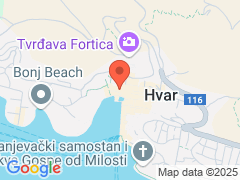
The cathedral is located at the eastern end of the main town square, right in the heart of Hvar's historic core.
It is just a few minutes' walk from the town harbour.
From the waterfront, head towards St Stephen's Square and continue straight across the spacious stone square.
The cathedral is easily recognisable by its bright façade and tall bell tower.
Access is straightforward for visitors arriving by catamaran, as the dock is not far from the historic core.
Direct access by car is not possible due to the pedestrian nature of the main town square.
The most practical option is to park in one of the public car parks outside the old town and continue on foot.
What to Visit Near the Cathedral
St Stephen's Cathedral is located in close proximity to several of Hvar's most important historical landmarks.
Next to it is the Bishop's Palace, which houses a valuable sacred collection.
On the western part of Pjaca is the Arsenal, a former important maritime building that now houses the Hvar Theatre, opened in 1612.
Nearby are the Renaissance Town Loggia and the clock tower Leroj, among the most recognisable monuments of former public architecture.
From the surrounding stone streets, you can continue your ascent to the Fortica fortress, which offers a panoramic view of the town, the cathedral bell tower, the harbour, and the Pakleni Islands.
In the historic core, there is also a Benedictine monastery, known for its tradition of making lace from agave threads.
Thus, a visit to the cathedral can easily be incorporated into a stroll through Hvar's most significant cultural landmarks.
Why Visit St Stephen's Cathedral in Hvar?
St Stephen's Cathedral is one of the most important historical and artistic landmarks on Hvar Island.
Its centuries-old history connects the medieval Benedictine tradition, the development of the Hvar Diocese, and the flourishing periods of Dalmatian Renaissance and Baroque.
The monumental façade with its trefoil finial and the Renaissance bell tower from the mid-16th century are among the most recognisable architectural symbols of the town.
Inside, valuable altars and artworks are preserved, while the historic crucifix from the Chapel of the Holy Cross and the relics of St Prosper reveal an important aspect of Hvar's religious tradition.
Situated in the main town square, the cathedral serves as a sacred space, a cultural monument, and a central part of Hvar's historical identity.
For anyone wishing to understand the history of the town, its architecture, and its connection to Dalmatian artistic heritage, a visit to the cathedral is one of the most important parts of exploring Hvar.
Useful Information
- Type of Attraction: Roman Catholic Cathedral, sacred and cultural-historical heritage
- Dedication: St Stephen I, Pope and Martyr
- Historical Origin: Site of the former Benedictine monastery of St Mary of Lesna
- Cathedral Status: Since the Middle Ages, traditionally associated with the 13th century
- Construction of the Current Cathedral: From the 16th to 18th century, with preserved older parts
- Architectural Style: Gothic, Renaissance, and Baroque
- Floor Plan: Three-nave basilica
- Façade: Late Renaissance with a trefoil finial symbolising the Holy Trinity
- Bell Tower: Renaissance, completed in the mid-16th century
- Valuable Artworks: Nine Baroque altars and paintings by Venetian masters, notably Palma il Giovane
- Special Historical Value: Gothic crucifix linked to the 1510 tradition
- Chapel: Chapel of the Holy Cross and Chapel of St Prosper
- Patron Saint of the Town: St Stephen I, Pope and Martyr
- Main Annual Celebration: Feast of St Stephen I and Day of the Town of Hvar, 2 October
- Duration of Visit: Approximately 20 to 30 minutes
- Entrance Fee for Tourist Visits: €2, according to the published price list
- Services: Regular masses and special church ceremonies
- Dress Code: Attire appropriate for a sacred space
- Photography: According to the rules highlighted in the church
- Access: On foot from the main town square and the town harbour
- Parking: Public parking outside the pedestrian zone
- Nearby: Bishop's Palace, cathedral treasury, Arsenal, Hvar Theatre, town loggia, and Fortica fortress
- Recommended for: Lovers of history, sacred art, architecture, and cultural heritage


St. Stephen's Cathedral / Comments
Looks like you are not signed in!
How would you like to proceed?
Anonymous comment
Login
Register
Your comment was submitted successfully and it will be published after approval by administrator!
General Conditions of Publiciation
General terms and conditions and notes
1. Web page
Web page www.holiday-link.com is an interactive web page where the visitors can put texts, news, photos and video movies regarding the content about tourism, gastronomy, culture and entertainment. Information can be uploaded by the owners, managers, employees, tourist boards, residents and tourists, basically all those who want to introduce the public to the specific content (facilities). The site allows evaluation of the attractiveness of a specific content and it allows writing comments by other visitors. Visitors, who log in and want to publish an information about some content (facility) or promote some tourist service, become users or suppliers and they agree to the general terms and conditions that are stipulated here and are obliged to act in accordance with the general terms and conditions (general conditions do not apply if a person is only visiting the page). A person can become a user by signing up with a user name and a password. The user agrees to put the accurate access data, name and surname and the address. Contents that users publish will be signed with a nickname they choose, while the personal data will be used in accordance with the privacy statement. Persons under the age of thirteen are not allowed to enter any content. General terms can be changed from time to time and if the user or supplier doesn’t agree with the changed general terms and conditions he can remove his content from the site.
2. Content
The page is not the media that publishes editorial program contents but the page where the visitors publish information that serve for the educational and cultural public informing about the touristic, cultural and gastronomic contents (facilities). The goal of the site is to collect the information that will give the tourists, as well as the locals, the insight into touristic, cultural and gastronomic offer of the certain location (city, region and country). Publishing the information about the content (information on facilities) is completely free of charge. Except the touristic content , on these pages, providers of various services in tourism may publish and advertise services they offer. These are, further in the text, referred to as a suppliers. Users and suppliers are solely responsible for the publication of their contents in accordance with the statement of responsibility.
3. User obligations
Each user is obliged to use the website in accordance with the general terms and conditions. By publishing the certain text, comment, photo or video movie on the site, the user guarantees that the published information are true, and that they are not copyrighted by a third party. Each user is morally and materially responsible for the publication of content. It is forbidden to copy texts from other websites. Administrators review entered contents and approve them for publishing. Holiday-Link.com has the right not to show the content it finds inappropriate, untrue or offensive. The owners, managers or employees of the gastronomic facilities (eg. restaurants) have the right to reply to the articles and comments on their own content. The owners have the right to request the removal of the text regarding their facilities if they find it inappropriate. The complaint can be send to complain@holiday-link.com. By publishing the content, the user is giving the exclusive, royalty-free, perpetual transferable, irrevocable and fully sublicensable licence (copyright) to use, reproduce modify, adapt, translate, distribute, publish and publicly display subscribed content to the Holiday-Link.com and its affiliates.
4. The obligations of suppliers of tourist services (accommodation and other services)
Company Holiday-Link.com Ltd acts as advertising website on this website and not as a tour operator or intermediary travel agency. Suppliers of tourist services who register their capacity on this site, pay the commercial advertising model they choose. Interaction, regarding arranging a specific accommodation or other tourist service, is done directly between supplier and visitor. Visitors arrange the accommodation or some other touristic service directly with the suppliers and pay the arranged service to them. Suppliers are responsible for all entered data, images, prices and more. Suppliers guarantee that they have all licences necessary to carry out the services they offer, and to operate in accordance with the laws of their home country. By purchasing certain service, visitor accepts the terms and conditions of a supplier from whom he purchased the service. Holiday-Link will check each supplier before putting its facilities to be visible on the page.
5. Statement of Responsibility
The information, that users and suppliers are entering, can be wrong. Holiday-Link.com does not check the entry of the information, pictures and movies and cannot guarantee their accuracy and it disclaims any responsibility for any incorrect data. If you notice a certain misstatement, inaccuracy or inadequacy in any content, please contact us by e-mail: complain@holiday-link.com The responsibility, for every information about some content, is on the user who entered the information. Suppliers, who advertise touristic services via this website, act as independent entrepreneurs. They enter the data about their services , as well as the pictures and the prices, on their own. Holiday-Link.com does not check entered data and disclaims responsibility regarding the errors that can occur during the entering. Suppliers have to own all the licences regarding the services they offer, and they have to respect the laws and regulations of the home country. Visitor arranges the specific service directly with the supplier, on the basis of data that is entered by a supplier as independent entrepreneur, and he pays it directly to the supplier. Therefore, Holiday-Link.com disclaims responsibility for any problem related to the certain reservation.
6. Privacy Policy
When logging into the website, users and suppliers have to enter some personal data (name and surname, e-mail, address, phone number, etc.). Holiday-Link.com guarantees that this data will be kept secret and will not be forwarded to the third parties. Holiday-Link.com can use an user and a supplier e-mail for sending necessarry informaion and for advertising.
7. Cookie Policy
Cookies are small text files that can be stored into device of a visitor if it is allowed by a web browser. Holiday-Link.com uses cookies to provide a better user experience on the website for the visitors. Also, while visiting Holiday-Link.com, you can automatically collect a certain data.
8. Court Jurisdiction
In case of any dispute, related to the site holiday-link.com, the court in Split and the Croatian law are competent.