St. Peter's Church, Vrboska – one of the oldest churches on Hvar by the harbour entrance
St. Peter's Church is situated right by the sea at the entrance to Vrboska harbour and is among the oldest preserved church sites on the island of Hvar. It is small, simple, and easily overlooked, yet it holds significant historical importance as it is first mentioned in 1331, at a time when the present-day settlements of Vrboska and Jelsa did not exist.
In contrast to the monumental fortress-like Church of St. Mary of Mercy or the richly adorned Church of St. Lawrence, St. Peter's is a modest stone chapel whose value lies primarily in its age, location, and the continuity of this site over nearly seven centuries.
First mentioned in 1331
St. Peter's Church is first referenced in the Hvar Statute from 1331.
The document describes communal pathways and the boundaries between Pitava and Vrbanj, or the Vrbanj field. It is particularly interesting that this occurs before the establishment of the current settlements of Vrboska and Jelsa.
As a result, St. Peter's Church is regarded as one of the oldest churches on Hvar and an important witness to the period preceding the development of Vrboska as a fishing and maritime community.
The current church is not entirely original
The church we see today is the result of centuries of destruction and restoration.
The original structure was destroyed in the early 15th century and was subsequently rebuilt in 1469.
Later modifications were made, and the church and the bell above the entrance were last thoroughly restored in 1999.
Despite these restorations, the chapel has retained its simple Dalmatian character – a small stone building with a narrow façade, a bell above the entrance, and very few decorative elements.
The statue of St. Peter and Nikola Firentinac
The most valuable artistic item associated with the church is the statue of St. Peter, a work by Nikola Firentinac, one of the most significant sculptors of the Croatian Renaissance.
The original statue is no longer located in this small chapel. It has been moved to the parish church of St. Lawrence in Vrboska, where the conditions for its preservation are more secure.
A copy of the original statue is located by St. Peter's Church, allowing visitors to see how the saint was depicted.
If you wish to see the original, you should visit the Church of St. Lawrence in the centre of Vrboska after St. Peter's.
A small church in an important location
The church's location is not coincidental.
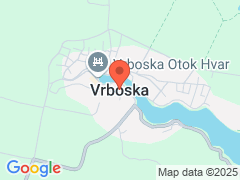
It is positioned right by the sea, at the entrance to the deep and naturally sheltered Vrboska harbour. For centuries, maritime traffic has flowed through this passage to the settlement, and the small church remains one of the first historical structures encountered when entering old Vrboska from the sea.
Today, it is surrounded by a marina, boats, and more modern facilities, but due to its small size and simple architecture, it still appears as a remnant of a much older landscape.
Can it be visited inside?
St. Peter's Church does not have reliably published regular tourist opening hours.
The doors are often closed, so visits should primarily be planned as an external tour. If the church is open for worship or a special occasion, it is possible to peek inside the simple interior.
If seeing the interior is important to you, it is best to inquire at the parish church of St. Lawrence or at the tourist office in Vrboska.
The original statue of St. Peter is not located here, but in the Church of St. Lawrence.
St. Peter's Church and the Za križen procession
St. Peter's chapel is not the main starting point for the Vrboska Za križen procession.
The procession from Vrboska begins at the parish church of St. Lawrence and returns there after the night procession. Therefore, St. Peter does not play the same role in the procession as St. Lawrence or the fortress-like Church of St. Mary.
Its significance is more historical than liturgical.
How to get there?
The church is located at the entrance to Vrboska harbour and can easily be included in a walk through the village.
It takes only a few minutes to walk from the centre of Vrboska to the church. The most pleasant route is along the coast, passing by boats and the marina.
A car is not necessary for the visit.
Parking
The church does not have its own parking for visitors.
The nearby ACI marina has its own parking, but this is part of the marina and should not be automatically considered public parking for church visitors.
If you are arriving by car, it is best to use public parking in Vrboska and continue the rest of the way on foot.
How much time is needed for a visit?
A visit to the church itself takes about ten to fifteen minutes.
If the doors are closed, the visit will be limited to viewing the façade, the statue, and the immediate surroundings. If the church is open, it is worth taking a brief look at the interior.
It makes the most sense to include it in a walk that encompasses the Church of St. Lawrence, the fortress-like Church of St. Mary of Mercy, and the Fishing Museum.
Why is it worth stopping by?
St. Peter's Church is not a landmark that impresses with its size.
It is worth seeing precisely for the opposite reason – it preserves one of the oldest documented traces of the sacred history of Vrboska and this entire part of Hvar in a very small space.
Knowing that the church was mentioned as early as 1331, before Vrboska and Jelsa even existed as present-day settlements, gives its simple stone façade a completely different significance.
Useful information
- Type of site: historical small church by the sea
- First written mention: 1331
- Historical significance: one of the oldest church sites on the island of Hvar
- Location: at the entrance to Vrboska harbour, right by the sea
- Restoration: the church was restored in 1469 after earlier destruction
- Last major restoration: the church and bell were restored in 1999
- Statue of St. Peter: original work by Nikola Firentinac
- Original statue: preserved in the parish church of St. Lawrence
- By the church: a copy of the original statue
- Interior visits: no regularly published tourist opening hours and the church is often locked
- Za križen procession: the church is not the main starting point for the Vrboska procession
- Distance from the centre of Vrboska: a few minutes' walk
- Parking: no own parking; use public parking in Vrboska
- Time for a visit: about 10 to 15 minutes
- Best for: history enthusiasts, lovers of sacred heritage, and old Dalmatian architecture


Church of St. Peter / Comments
Looks like you are not signed in!
How would you like to proceed?
Anonymous comment
Login
Register
Your comment was submitted successfully and it will be published after approval by administrator!
General Conditions of Publiciation
General terms and conditions and notes
1. Web page
Web page www.holiday-link.com is an interactive web page where the visitors can put texts, news, photos and video movies regarding the content about tourism, gastronomy, culture and entertainment. Information can be uploaded by the owners, managers, employees, tourist boards, residents and tourists, basically all those who want to introduce the public to the specific content (facilities). The site allows evaluation of the attractiveness of a specific content and it allows writing comments by other visitors. Visitors, who log in and want to publish an information about some content (facility) or promote some tourist service, become users or suppliers and they agree to the general terms and conditions that are stipulated here and are obliged to act in accordance with the general terms and conditions (general conditions do not apply if a person is only visiting the page). A person can become a user by signing up with a user name and a password. The user agrees to put the accurate access data, name and surname and the address. Contents that users publish will be signed with a nickname they choose, while the personal data will be used in accordance with the privacy statement. Persons under the age of thirteen are not allowed to enter any content. General terms can be changed from time to time and if the user or supplier doesn’t agree with the changed general terms and conditions he can remove his content from the site.
2. Content
The page is not the media that publishes editorial program contents but the page where the visitors publish information that serve for the educational and cultural public informing about the touristic, cultural and gastronomic contents (facilities). The goal of the site is to collect the information that will give the tourists, as well as the locals, the insight into touristic, cultural and gastronomic offer of the certain location (city, region and country). Publishing the information about the content (information on facilities) is completely free of charge. Except the touristic content , on these pages, providers of various services in tourism may publish and advertise services they offer. These are, further in the text, referred to as a suppliers. Users and suppliers are solely responsible for the publication of their contents in accordance with the statement of responsibility.
3. User obligations
Each user is obliged to use the website in accordance with the general terms and conditions. By publishing the certain text, comment, photo or video movie on the site, the user guarantees that the published information are true, and that they are not copyrighted by a third party. Each user is morally and materially responsible for the publication of content. It is forbidden to copy texts from other websites. Administrators review entered contents and approve them for publishing. Holiday-Link.com has the right not to show the content it finds inappropriate, untrue or offensive. The owners, managers or employees of the gastronomic facilities (eg. restaurants) have the right to reply to the articles and comments on their own content. The owners have the right to request the removal of the text regarding their facilities if they find it inappropriate. The complaint can be send to complain@holiday-link.com. By publishing the content, the user is giving the exclusive, royalty-free, perpetual transferable, irrevocable and fully sublicensable licence (copyright) to use, reproduce modify, adapt, translate, distribute, publish and publicly display subscribed content to the Holiday-Link.com and its affiliates.
4. The obligations of suppliers of tourist services (accommodation and other services)
Company Holiday-Link.com Ltd acts as advertising website on this website and not as a tour operator or intermediary travel agency. Suppliers of tourist services who register their capacity on this site, pay the commercial advertising model they choose. Interaction, regarding arranging a specific accommodation or other tourist service, is done directly between supplier and visitor. Visitors arrange the accommodation or some other touristic service directly with the suppliers and pay the arranged service to them. Suppliers are responsible for all entered data, images, prices and more. Suppliers guarantee that they have all licences necessary to carry out the services they offer, and to operate in accordance with the laws of their home country. By purchasing certain service, visitor accepts the terms and conditions of a supplier from whom he purchased the service. Holiday-Link will check each supplier before putting its facilities to be visible on the page.
5. Statement of Responsibility
The information, that users and suppliers are entering, can be wrong. Holiday-Link.com does not check the entry of the information, pictures and movies and cannot guarantee their accuracy and it disclaims any responsibility for any incorrect data. If you notice a certain misstatement, inaccuracy or inadequacy in any content, please contact us by e-mail: complain@holiday-link.com The responsibility, for every information about some content, is on the user who entered the information. Suppliers, who advertise touristic services via this website, act as independent entrepreneurs. They enter the data about their services , as well as the pictures and the prices, on their own. Holiday-Link.com does not check entered data and disclaims responsibility regarding the errors that can occur during the entering. Suppliers have to own all the licences regarding the services they offer, and they have to respect the laws and regulations of the home country. Visitor arranges the specific service directly with the supplier, on the basis of data that is entered by a supplier as independent entrepreneur, and he pays it directly to the supplier. Therefore, Holiday-Link.com disclaims responsibility for any problem related to the certain reservation.
6. Privacy Policy
When logging into the website, users and suppliers have to enter some personal data (name and surname, e-mail, address, phone number, etc.). Holiday-Link.com guarantees that this data will be kept secret and will not be forwarded to the third parties. Holiday-Link.com can use an user and a supplier e-mail for sending necessarry informaion and for advertising.
7. Cookie Policy
Cookies are small text files that can be stored into device of a visitor if it is allowed by a web browser. Holiday-Link.com uses cookies to provide a better user experience on the website for the visitors. Also, while visiting Holiday-Link.com, you can automatically collect a certain data.
8. Court Jurisdiction
In case of any dispute, related to the site holiday-link.com, the court in Split and the Croatian law are competent.