Diocletian's Fish Pond in Nečujam – a Roman site hidden in the shallow waters of Piškera Bay
Diocletian's Fish Pond is located in Piškera Bay, one of the smallest and most deeply recessed bays within the larger Nečujam Bay. It is not a landmark that can be seen from the road like a church or an old stone house. The most significant part of the site lies underwater at the entrance to the small bay, meaning many visitors pass by unaware that they are looking at the remains of a structure nearly two thousand years old.
In Nečujam, it is commonly referred to as Diocletian's Fish Pond, a name used by the Šolta Municipality, tourism and media sources, as well as project documentation related to the site's protection. However, it is important to distinguish what has been archaeologically confirmed from the stories passed down through generations. It is reliably confirmed that there was a large ancient fish pond, or Roman piscina vivaria, intended for the storage and breeding of live fish in Piškera. Direct evidence that the pond personally belonged to Emperor Diocletian has not yet been found. Therefore, it is most accurate to say that it is a Roman fish pond known as Diocletian's Fish Pond.
The name Piškera is associated with the Latin word piscina, meaning pool or fish pond. In antiquity, almost the entire end of the bay was separated from the open sea by a large stone wall. In the middle of the wall, there was a passage about three metres wide, closed off by a special barrier that allowed seawater to flow in but prevented fish from escaping. This way, live fish could be kept in the naturally sheltered and shallow bay until needed by the residents of the nearby villa or for supplying other locations.
The remains of the wall and embankment are now submerged, but they can still be discerned beneath the surface in calm waters. The site extends approximately 70 by 10 metres, with a depth of around three to five metres in the area. The waters in Piškera are generally calm, with weak currents and good visibility, making the wall most visible on sunny days when there are no waves and when viewed from above or with the aid of a snorkel. Diving is permitted, but the remains must not be touched, moved, or used for anchoring, as it is a protected underwater archaeological site.
Adjacent to the fish pond was a Roman villa, likely of the villa maritima type, which was a coastal agricultural estate. Archaeological literature indicates that the villa was located right by Piškera, but it has not yet been systematically researched. Such villas were not merely places of rest for wealthy owners; they managed agricultural estates, wine and oil production, fishing, maritime trade, and the supply of ships and surrounding settlements. In the immediate hinterland of Nečujam, there are fertile areas suitable for vineyards and olive groves, so the location by a safe bay also had economic significance.
The connection of the site to Diocletian is primarily based on local tradition, the time of the pond's creation, and its proximity to Split, where the emperor built his palace in the early 4th century. Šolta documents and tourist interpretations suggest that Diocletian stayed in Nečujam and used the bay as a fish pond, with occasional mentions of baths. However, archaeological sources speak more cautiously about the Roman fish pond and note that the bay is popularly referred to as Diocletian's Fish Pond. Therefore, it is best to retain the well-known name for the article, but not to assert that Diocletian's ownership is conclusively proven.
Visiting the site is now much simpler than before. Around Piškera Bay, a thematic walking path approximately 400 metres long has been established as part of the "Eco Šolta – Below and Above" project. During this project, the seabed was cleaned, the coastline was arranged, and access to the site was improved. The path follows the calm edge of the bay and allows views of the submerged wall from multiple points, while interpretive signs help visitors understand what lies beneath the surface of the sea.
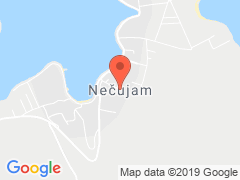
Piškera is located about one and a half kilometres from the main part of Nečujam and the central beach. It can be reached on foot, by bicycle, scooter, or car via the local road through the settlement. Walking is more pleasant outside the hottest part of the day, as the route involves some ups and downs through the rugged area of Nečujam. Accommodation facilities in the bay indicate a distance of about 1.5 kilometres to the centre and shops, which is a useful guideline for planning your visit.
There is no large public parking area near the bay. Space is limited, the road is narrow in places, and some areas near houses are reserved for local residents and accommodation guests. It is best to leave your car in a safe widening without blocking access to houses and continue the last part on foot. During the main season, a scooter, bicycle, or walking from Nečujam is more practical.
No ticket or specific opening hours are required for viewing, as the site can be observed from the public shore and path. The best times to visit are in the morning or later in the afternoon when the sun is at a more favourable angle and the underwater wall becomes more visible. For a closer look, a mask and snorkel are useful, but one should not enter among the moored boats or swim through their navigable passage. The bay has local moorings, and the central opening through the ancient wall must remain passable for smaller vessels.
Diocletian's Fish Pond is not a spectacular site in the classical sense. There are no high walls, large columns, or restored Roman rooms. Its value lies precisely in the fact that the original structure remains where it was in antiquity – between land and sea. When the line of the stone wall beneath the surface is recognised from the shore, it becomes clear that the tranquil Piškera Bay is not just a place for swimming and mooring boats, but one of the most interesting traces of Roman life on Šolta.


Ancient Diocletian’s Fishpond / Comments
Looks like you are not signed in!
How would you like to proceed?
Anonymous comment
Login
Register
Your comment was submitted successfully and it will be published after approval by administrator!
General Conditions of Publiciation
General terms and conditions and notes
1. Web page
Web page www.holiday-link.com is an interactive web page where the visitors can put texts, news, photos and video movies regarding the content about tourism, gastronomy, culture and entertainment. Information can be uploaded by the owners, managers, employees, tourist boards, residents and tourists, basically all those who want to introduce the public to the specific content (facilities). The site allows evaluation of the attractiveness of a specific content and it allows writing comments by other visitors. Visitors, who log in and want to publish an information about some content (facility) or promote some tourist service, become users or suppliers and they agree to the general terms and conditions that are stipulated here and are obliged to act in accordance with the general terms and conditions (general conditions do not apply if a person is only visiting the page). A person can become a user by signing up with a user name and a password. The user agrees to put the accurate access data, name and surname and the address. Contents that users publish will be signed with a nickname they choose, while the personal data will be used in accordance with the privacy statement. Persons under the age of thirteen are not allowed to enter any content. General terms can be changed from time to time and if the user or supplier doesn’t agree with the changed general terms and conditions he can remove his content from the site.
2. Content
The page is not the media that publishes editorial program contents but the page where the visitors publish information that serve for the educational and cultural public informing about the touristic, cultural and gastronomic contents (facilities). The goal of the site is to collect the information that will give the tourists, as well as the locals, the insight into touristic, cultural and gastronomic offer of the certain location (city, region and country). Publishing the information about the content (information on facilities) is completely free of charge. Except the touristic content , on these pages, providers of various services in tourism may publish and advertise services they offer. These are, further in the text, referred to as a suppliers. Users and suppliers are solely responsible for the publication of their contents in accordance with the statement of responsibility.
3. User obligations
Each user is obliged to use the website in accordance with the general terms and conditions. By publishing the certain text, comment, photo or video movie on the site, the user guarantees that the published information are true, and that they are not copyrighted by a third party. Each user is morally and materially responsible for the publication of content. It is forbidden to copy texts from other websites. Administrators review entered contents and approve them for publishing. Holiday-Link.com has the right not to show the content it finds inappropriate, untrue or offensive. The owners, managers or employees of the gastronomic facilities (eg. restaurants) have the right to reply to the articles and comments on their own content. The owners have the right to request the removal of the text regarding their facilities if they find it inappropriate. The complaint can be send to complain@holiday-link.com. By publishing the content, the user is giving the exclusive, royalty-free, perpetual transferable, irrevocable and fully sublicensable licence (copyright) to use, reproduce modify, adapt, translate, distribute, publish and publicly display subscribed content to the Holiday-Link.com and its affiliates.
4. The obligations of suppliers of tourist services (accommodation and other services)
Company Holiday-Link.com Ltd acts as advertising website on this website and not as a tour operator or intermediary travel agency. Suppliers of tourist services who register their capacity on this site, pay the commercial advertising model they choose. Interaction, regarding arranging a specific accommodation or other tourist service, is done directly between supplier and visitor. Visitors arrange the accommodation or some other touristic service directly with the suppliers and pay the arranged service to them. Suppliers are responsible for all entered data, images, prices and more. Suppliers guarantee that they have all licences necessary to carry out the services they offer, and to operate in accordance with the laws of their home country. By purchasing certain service, visitor accepts the terms and conditions of a supplier from whom he purchased the service. Holiday-Link will check each supplier before putting its facilities to be visible on the page.
5. Statement of Responsibility
The information, that users and suppliers are entering, can be wrong. Holiday-Link.com does not check the entry of the information, pictures and movies and cannot guarantee their accuracy and it disclaims any responsibility for any incorrect data. If you notice a certain misstatement, inaccuracy or inadequacy in any content, please contact us by e-mail: complain@holiday-link.com The responsibility, for every information about some content, is on the user who entered the information. Suppliers, who advertise touristic services via this website, act as independent entrepreneurs. They enter the data about their services , as well as the pictures and the prices, on their own. Holiday-Link.com does not check entered data and disclaims responsibility regarding the errors that can occur during the entering. Suppliers have to own all the licences regarding the services they offer, and they have to respect the laws and regulations of the home country. Visitor arranges the specific service directly with the supplier, on the basis of data that is entered by a supplier as independent entrepreneur, and he pays it directly to the supplier. Therefore, Holiday-Link.com disclaims responsibility for any problem related to the certain reservation.
6. Privacy Policy
When logging into the website, users and suppliers have to enter some personal data (name and surname, e-mail, address, phone number, etc.). Holiday-Link.com guarantees that this data will be kept secret and will not be forwarded to the third parties. Holiday-Link.com can use an user and a supplier e-mail for sending necessarry informaion and for advertising.
7. Cookie Policy
Cookies are small text files that can be stored into device of a visitor if it is allowed by a web browser. Holiday-Link.com uses cookies to provide a better user experience on the website for the visitors. Also, while visiting Holiday-Link.com, you can automatically collect a certain data.
8. Court Jurisdiction
In case of any dispute, related to the site holiday-link.com, the court in Split and the Croatian law are competent.