Church of St. Roch in Komiža – An Unusual Fortified Church by the Sea
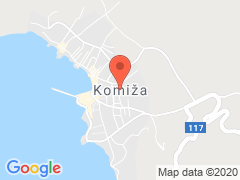
The Church of St. Roch is located on the southern side of Komiža, along the coast and at the former entrance to the town. At first glance, it can easily be mistaken for a small stone tower due to its atypical appearance for a Dalmatian church. There are almost no windows, the walls are massive, gunports are visible next to the door, and the entire structure is designed to serve as shelter in case of an attack.
This is precisely why St. Roch is worth including in a walk around Komiža. It is not a large church nor a place that requires an hour of your time, but it is one of the architecturally most unusual sacred buildings in the town and a good reminder of a time when danger from the sea came not only from storms but also from pirate attacks.
A Church Has Existed at This Site Since the 16th Century
The first Church of St. Roch at this location was built in the 16th century. It was dedicated to St. Roch, a saint to whom people particularly turned for protection against plague and other infectious diseases.
Such votive churches were not uncommon along the Dalmatian coast, but the Komiža St. Roch later took on another role – that of defense.
The old church did not completely disappear when the current structure was erected. Its space was incorporated into the new complex and transformed into a sacristy, so today’s St. Roch actually preserves parts from two different construction phases.
The Current Church Was Built by the Mardešić Family in 1763
In 1763, the Komiža family Mardešić received permission from the Bishop of Hvar, Jakov Pontalija, to build a new Church of St. Roch.
Instead of a classic church with large windows and a prominent apse, a structure resembling a defensive tower was constructed.
This solution was not accidental. For centuries, Komiža was exposed to the sea, and attackers came from the sea. Therefore, fortified churches and monasteries were built on the Adriatic islands that could serve as shelter for residents in times of danger.
St. Roch is one of the well-preserved examples of such construction.
Observe the Gunports Next to the Entrance
The most interesting details are best seen from the outside.
On the sides next to the door, there are gunports designed to defend the entrance to the church. Above the door, there is also a defensive stone element from which the area directly in front of the entrance could be monitored.
The walls have almost no classic windows. The facade features a round opening, and additional smaller windows are positioned high under the roof. The church also lacks the usual prominent apse.
When all of this is viewed together, it becomes much clearer why St. Roch is often described as a fortified church.
It is best to approach it from all available sides, rather than just photographing the facade. The defensive elements that distinguish this small church from others in Komiža are most visible on the side walls.
The Small Bell Tower Is Not from the Time of the Church's Construction
The bell tower can also be misleading.
The small bell tower visible on the church today is not part of the original structure from 1763. It was added in the 20th century and was relocated from an older part of the church that became the sacristy after the new building was constructed.
Thus, the current appearance of St. Roch is the result of several different periods, although the entire structure appears very harmonious and simple at first glance.
What Is Inside
The interior is much simpler than one might expect based on the unusual exterior appearance.
Inside the church, there is a late Baroque altar with a painting by an Italian artist from the 19th century. The main value of St. Roch lies not in the number of artworks but in the architecture itself and the combination of sacred and defensive purposes.
For this reason, the church is interesting even if entry is not possible during a visit. Most of what makes it special can be clearly seen from the outside.
Why St. Roch?
St. Roch has been one of the most important protectors against plague for centuries. His churches and chapels were often built after epidemics or as a vow for the protection of the population from diseases.
In Komiža, this is particularly interesting because the church has come to protect the residents in two ways over time – symbolically from illness and, with its sturdy walls, very tangibly from attackers.
This is actually the whole uniqueness of this place. St. Roch is not just another one of several old churches in Komiža, but a building that shows how architecture adapted to the real dangers of life on a remote Adriatic island.
It Is Easy to Include in a Walk Around Komiža
The church is located in the southern part of the settlement and can be reached on foot from the center. No special trip is needed from the main Komiža waterfront – it is sufficient to continue walking towards the southern part of Komiža.
For this reason, it is best not to arrive by car. Old Komiža and the coastal area are much easier to explore on foot, and you will pass by other interesting parts of the town along the way.
A visit to the church itself from the outside takes about ten minutes. If you take photographs, examine the gunports, and look at the old part of the building, you can expect to spend a bit longer.
It Is Good to Connect It with the Southern Part of Komiža
St. Roch makes the most sense as part of a longer walk through the town. After the waterfront and the Komuna, you can continue towards the old streets of Komiža and then to the southern side of the settlement and the coast.
This way, in a relatively short walk, you can see completely different faces of Komiža: the representative Komuna on the waterfront, the old stone houses, and the small fortified church that once marked the entrance to the town.
If you continue towards the beaches south of the center, St. Roch can be a brief stop without the need to organize a special visit for it.
Is It Worth Seeking Out Specifically?
Yes, but primarily because of its unusual architecture.
The Muster is more important for the overall history of Komiža, Our Lady of Gusarica is better known for its story and location by the beach, and the Komuna and Fishing Museum best represent the fishing tradition of the town. St. Roch is interesting for something entirely different – it looks like a small fortress that accidentally became a church.
When you get closer and notice the gunports, almost completely closed walls, and the defensive entrance, it becomes clear that this appearance is not just decoration. The church was built at a time when the possibility of attacks from the sea was part of everyday life.
For this reason, the Church of St. Roch deserves a brief stop during a visit to Komiža, especially for those interested in old architecture and lesser-known traces of island history.


Church of St. Roch / Comments
Looks like you are not signed in!
How would you like to proceed?
Anonymous comment
Login
Register
Your comment was submitted successfully and it will be published after approval by administrator!
General Conditions of Publication
General Conditions of Publiciation
1. Web page
Web page www.holiday-link.com is an interactive web page where the visitors can put texts, news, photos and video movies regarding the content about tourism, gastronomy, culture and entertainment. Information can be uploaded by the owners, managers, employees, tourist boards, residents and tourists, basically all those who want to introduce the public to the specific content (facilities). The site allows evaluation of the attractiveness of a specific content and it allows writing comments by other visitors. Visitors, who log in and want to publish an information about some content (facility) or promote some tourist service, become users or suppliers and they agree to the general terms and conditions that are stipulated here and are obliged to act in accordance with the general terms and conditions (general conditions do not apply if a person is only visiting the page). A person can become a user by signing up with a user name and a password. The user agrees to put the accurate access data, name and surname and the address. Contents that users publish will be signed with a nickname they choose, while the personal data will be used in accordance with the privacy statement. Persons under the age of thirteen are not allowed to enter any content. General terms can be changed from time to time and if the user or supplier doesn’t agree with the changed general terms and conditions he can remove his content from the site.
2. Content
The page is not the media that publishes editorial program contents but the page where the visitors publish information that serve for the educational and cultural public informing about the touristic, cultural and gastronomic contents (facilities). The goal of the site is to collect the information that will give the tourists, as well as the locals, the insight into touristic, cultural and gastronomic offer of the certain location (city, region and country). Publishing the information about the content (information on facilities) is completely free of charge. Except the touristic content , on these pages, providers of various services in tourism may publish and advertise services they offer. These are, further in the text, referred to as a suppliers. Users and suppliers are solely responsible for the publication of their contents in accordance with the statement of responsibility.
3. User obligations
Each user is obliged to use the website in accordance with the general terms and conditions. By publishing the certain text, comment, photo or video movie on the site, the user guarantees that the published information are true, and that they are not copyrighted by a third party. Each user is morally and materially responsible for the publication of content. It is forbidden to copy texts from other websites. Administrators review entered contents and approve them for publishing. Holiday-Link.com has the right not to show the content it finds inappropriate, untrue or offensive. The owners, managers or employees of the gastronomic facilities (eg. restaurants) have the right to reply to the articles and comments on their own content. The owners have the right to request the removal of the text regarding their facilities if they find it inappropriate. The complaint can be send to complain@holiday-link.com. By publishing the content, the user is giving the exclusive, royalty-free, perpetual transferable, irrevocable and fully sublicensable licence (copyright) to use, reproduce modify, adapt, translate, distribute, publish and publicly display subscribed content to the Holiday-Link.com and its affiliates.
4. The obligations of suppliers of tourist services (accommodation and other services)
Company Holiday-Link.com Ltd acts as advertising website on this website and not as a tour operator or intermediary travel agency. Suppliers of tourist services who register their capacity on this site, pay the commercial advertising model they choose. Interaction, regarding arranging a specific accommodation or other tourist service, is done directly between supplier and visitor. Visitors arrange the accommodation or some other touristic service directly with the suppliers and pay the arranged service to them. Suppliers are responsible for all entered data, images, prices and more. Suppliers guarantee that they have all licences necessary to carry out the services they offer, and to operate in accordance with the laws of their home country. By purchasing certain service, visitor accepts the terms and conditions of a supplier from whom he purchased the service. Holiday-Link will check each supplier before putting its facilities to be visible on the page.
5. Statement of Responsibility
The information, that users and suppliers are entering, can be wrong. Holiday-Link.com does not check the entry of the information, pictures and movies and cannot guarantee their accuracy and it disclaims any responsibility for any incorrect data. If you notice a certain misstatement, inaccuracy or inadequacy in any content, please contact us by e-mail: complain@holiday-link.com The responsibility, for every information about some content, is on the user who entered the information. Suppliers, who advertise touristic services via this website, act as independent entrepreneurs. They enter the data about their services , as well as the pictures and the prices, on their own. Holiday-Link.com does not check entered data and disclaims responsibility regarding the errors that can occur during the entering. Suppliers have to own all the licences regarding the services they offer, and they have to respect the laws and regulations of the home country. Visitor arranges the specific service directly with the supplier, on the basis of data that is entered by a supplier as independent entrepreneur, and he pays it directly to the supplier. Therefore, Holiday-Link.com disclaims responsibility for any problem related to the certain reservation.
6. Privacy Policy
When logging into the website, users and suppliers have to enter some personal data (name and surname, e-mail, address, phone number, etc.). Holiday-Link.com guarantees that this data will be kept secret and will not be forwarded to the third parties. Holiday-Link.com can use an user and a supplier e-mail for sending necessarry informaion and for advertising.
7. Cookie Policy
Cookies are small text files that can be stored into device of a visitor if it is allowed by a web browser. Holiday-Link.com uses cookies to provide a better user experience on the website for the visitors. Also, while visiting Holiday-Link.com, you can automatically collect a certain data.
8. Court Jurisdiction
In case of any dispute, related to the site holiday-link.com, the court in Split and the Croatian law are competent.