Church of St. Lucy in Stari Grad – History of the Dominican Monastery, the Tragic Year of 1571, and Centuries-Old Customs
The Church of St. Lucy in Stari Grad on the island of Hvar is a historic church linked to the former women's Dominican monastery, the suffering of the nuns during the Ottoman attack in 1571, and the long-standing veneration of St. Lucy. Located on the southeastern edge of the old town core, the church is notable for its unusual architectural shape, valuable stone sculptures, and the remains of the monastery that existed at this site in the early 16th century. It holds a special place in the lives of the residents of Stari Grad every December 13, when traditional customs of lighting a large fire and giving gifts to children are observed in conjunction with the feast of St. Lucy.
History of the Church of St. Lucy and the Dominican Monastery
The history of the church begins around 1500, when the priest Nikola Barbeta built the church and monastery intended for Dominican tertiary nuns, known in Dalmatia as picokare.
The monastery and church were originally dedicated to St. Vincent Ferrer, a Dominican preacher and saint. Within the monastery, the nuns lived in a community devoted to prayer and religious life, and the church served as their spiritual center.
The most tragic event in the monastery's history occurred in 1571 during the Ottoman attack on the island of Hvar. The attackers set fire to the monastery, and five nuns were killed in the assault.
The memory of their death is preserved in the sacred heritage of Stari Grad. In the museum collection of the Dominican monastery, there is a stone relief depicting the five martyred nuns and the risen Christ, which serves as a valuable historical and religious memorial of this event.
The former monastic community gradually disappeared, and the monastery was last mentioned as active in 1753. However, the church continued to exist and was thoroughly renovated and redesigned in 1873. It was at this time that its titular was changed, and it was dedicated to St. Lucy, who had been venerated at this site previously.
Unusual Architecture and Preserved Parts of the Old Church
Unlike typical Dalmatian churches with elongated naves and clearly defined facades, the Church of St. Lucy has an unusual rectangular floor plan, with the building being wider than it is long.
The current shape was acquired during the major renovation in 1873. Due to its proportions and four-pitched roof, it partially resembles a traditional stone house from the outside, making it a particularly interesting example of sacred architecture in Stari Grad.
The building shows various phases of construction. The lower parts of some walls were built with smaller, regularly layered stone, while later additions were made with larger stone blocks.
The original Gothic church's apse has been preserved and now serves as a sacristy. The facade features a small bell tower on a belfry, and a particularly valuable detail is the stone sculpture of Christ located in a niche above the entrance, which local heritage documentation dates to the 15th century.
Inside, there is also a colored stone statue of St. Lucy, approximately 85 centimeters tall. It was made in the Gothic tradition and is attributed to a regional sculptural workshop from the 16th century. The statue once stood on the main altar and is mentioned in episcopal visitations from the 17th century.
Remains of the Monastery and the Memory of the Five Martyred Nuns
Adjacent to the church are the remains of the former Dominican monastery. Although most of the complex has disappeared over the centuries, the preserved walls allow for the recognition of the space where the community of Dominican tertiary nuns once operated.
The northern wall of the former monastic complex, located east of the current church, is particularly important. It is believed that the original church was located in the western part of this complex.
The ruins serve as a valuable reminder of the destruction that Stari Grad suffered during the Ottoman incursions in the 16th century.
The story of the five slain nuns gives this site a special place in the town's history. While many churches in Stari Grad testify to the development of architecture and art, the Church of St. Lucy also preserves the memory of one of the most difficult episodes of monastic life on the island.
The Feast of St. Lucy and Traditional Customs on December 13
The Church of St. Lucy is still associated with one of the recognizable December traditions of Stari Grad.
On the feast of St. Lucy, December 13, a large fire is traditionally lit in front of the church, around which residents gather. This custom connects the religious celebration with the old island tradition of communal gathering before Christmas.
Particularly interesting is the custom of giving gifts to children. According to Stari Grad tradition, St. Lucy brings gifts to children that are hidden in a stocking, making this feast especially dear to the youngest.
St. Lucy was an early Christian martyr from Syracuse in Sicily, and in Christian tradition, she is venerated as the protector of sight and eyes. Her name is associated with the Latin word lux, meaning light. For this reason, the symbolism of light holds an important place in the customs related to her feast.
In Croatia, December 13 is also known for the custom of sowing Christmas wheat, which symbolizes life, renewal, and prosperity.
Location of the Church of St. Lucy and How to Get There
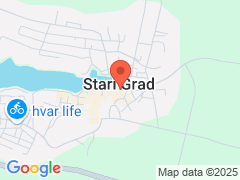
The Church of St. Lucy is located on the southeastern edge of the historical core of Stari Grad, south of the early Christian church of St. John. It is situated outside the busiest part of the town center but close enough to other landmarks to easily include it in a walking tour.
From the Stari Grad waterfront, the church can be reached by walking through the stone streets of the old town. Nearby is also the church of St. John, one of the most important early Christian monuments on the island of Hvar.
When visiting, it is worth exploring the exterior of the church and viewing the remains of the former monastery. For history enthusiasts, it is particularly interesting to connect this site with the Dominican monastery of St. Peter the Martyr, where a relief dedicated to the martyred nuns is preserved.
The most practical way to reach the church is on foot, while cars can be parked in public parking areas in Stari Grad and then continued towards the historical core.
Useful Information
- Location: Stari Grad, Hvar Island, Croatia
- Type of Landmark: Historical church and remains of a Dominican monastery
- Year of Establishment: Around 1500
- Original Dedication: St. Vincent Ferrer
- Current Dedication: St. Lucy, since the renovation in 1873
- Historical Significance: Former monastery of Dominican tertiary nuns, destroyed in the Ottoman attack of 1571
- Architectural Features: Unusual rectangular floor plan, four-pitched roof, preserved Gothic apse and belfry
- Notable Artistic Details: Stone sculpture of Christ from the 15th century and statue of St. Lucy from the 16th century
- Feast of the Patron: December 13
- Traditional Customs: Lighting a large fire and giving gifts to children
- Access: On foot from the historical core of Stari Grad
- Parking: Public parking areas in Stari Grad
- Nearby: Church of St. John, remains of the ancient Faros, and Dominican monastery of St. Peter the Martyr
- Recommended for: History enthusiasts, sacred art, cultural heritage, and local customs


Crkva sv. Lucije / Comments
Looks like you are not signed in!
How would you like to proceed?
Anonymous comment
Login
Register
Your comment was submitted successfully and it will be published after approval by administrator!
General Conditions of Publication
General Conditions of Publiciation
1. Web page
Web page www.holiday-link.com is an interactive web page where the visitors can put texts, news, photos and video movies regarding the content about tourism, gastronomy, culture and entertainment. Information can be uploaded by the owners, managers, employees, tourist boards, residents and tourists, basically all those who want to introduce the public to the specific content (facilities). The site allows evaluation of the attractiveness of a specific content and it allows writing comments by other visitors. Visitors, who log in and want to publish an information about some content (facility) or promote some tourist service, become users or suppliers and they agree to the general terms and conditions that are stipulated here and are obliged to act in accordance with the general terms and conditions (general conditions do not apply if a person is only visiting the page). A person can become a user by signing up with a user name and a password. The user agrees to put the accurate access data, name and surname and the address. Contents that users publish will be signed with a nickname they choose, while the personal data will be used in accordance with the privacy statement. Persons under the age of thirteen are not allowed to enter any content. General terms can be changed from time to time and if the user or supplier doesn’t agree with the changed general terms and conditions he can remove his content from the site.
2. Content
The page is not the media that publishes editorial program contents but the page where the visitors publish information that serve for the educational and cultural public informing about the touristic, cultural and gastronomic contents (facilities). The goal of the site is to collect the information that will give the tourists, as well as the locals, the insight into touristic, cultural and gastronomic offer of the certain location (city, region and country). Publishing the information about the content (information on facilities) is completely free of charge. Except the touristic content , on these pages, providers of various services in tourism may publish and advertise services they offer. These are, further in the text, referred to as a suppliers. Users and suppliers are solely responsible for the publication of their contents in accordance with the statement of responsibility.
3. User obligations
Each user is obliged to use the website in accordance with the general terms and conditions. By publishing the certain text, comment, photo or video movie on the site, the user guarantees that the published information are true, and that they are not copyrighted by a third party. Each user is morally and materially responsible for the publication of content. It is forbidden to copy texts from other websites. Administrators review entered contents and approve them for publishing. Holiday-Link.com has the right not to show the content it finds inappropriate, untrue or offensive. The owners, managers or employees of the gastronomic facilities (eg. restaurants) have the right to reply to the articles and comments on their own content. The owners have the right to request the removal of the text regarding their facilities if they find it inappropriate. The complaint can be send to complain@holiday-link.com. By publishing the content, the user is giving the exclusive, royalty-free, perpetual transferable, irrevocable and fully sublicensable licence (copyright) to use, reproduce modify, adapt, translate, distribute, publish and publicly display subscribed content to the Holiday-Link.com and its affiliates.
4. The obligations of suppliers of tourist services (accommodation and other services)
Company Holiday-Link.com Ltd acts as advertising website on this website and not as a tour operator or intermediary travel agency. Suppliers of tourist services who register their capacity on this site, pay the commercial advertising model they choose. Interaction, regarding arranging a specific accommodation or other tourist service, is done directly between supplier and visitor. Visitors arrange the accommodation or some other touristic service directly with the suppliers and pay the arranged service to them. Suppliers are responsible for all entered data, images, prices and more. Suppliers guarantee that they have all licences necessary to carry out the services they offer, and to operate in accordance with the laws of their home country. By purchasing certain service, visitor accepts the terms and conditions of a supplier from whom he purchased the service. Holiday-Link will check each supplier before putting its facilities to be visible on the page.
5. Statement of Responsibility
The information, that users and suppliers are entering, can be wrong. Holiday-Link.com does not check the entry of the information, pictures and movies and cannot guarantee their accuracy and it disclaims any responsibility for any incorrect data. If you notice a certain misstatement, inaccuracy or inadequacy in any content, please contact us by e-mail: complain@holiday-link.com The responsibility, for every information about some content, is on the user who entered the information. Suppliers, who advertise touristic services via this website, act as independent entrepreneurs. They enter the data about their services , as well as the pictures and the prices, on their own. Holiday-Link.com does not check entered data and disclaims responsibility regarding the errors that can occur during the entering. Suppliers have to own all the licences regarding the services they offer, and they have to respect the laws and regulations of the home country. Visitor arranges the specific service directly with the supplier, on the basis of data that is entered by a supplier as independent entrepreneur, and he pays it directly to the supplier. Therefore, Holiday-Link.com disclaims responsibility for any problem related to the certain reservation.
6. Privacy Policy
When logging into the website, users and suppliers have to enter some personal data (name and surname, e-mail, address, phone number, etc.). Holiday-Link.com guarantees that this data will be kept secret and will not be forwarded to the third parties. Holiday-Link.com can use an user and a supplier e-mail for sending necessarry informaion and for advertising.
7. Cookie Policy
Cookies are small text files that can be stored into device of a visitor if it is allowed by a web browser. Holiday-Link.com uses cookies to provide a better user experience on the website for the visitors. Also, while visiting Holiday-Link.com, you can automatically collect a certain data.
8. Court Jurisdiction
In case of any dispute, related to the site holiday-link.com, the court in Split and the Croatian law are competent.